












| 
Zhou Yongkang (C, front), member of the Standing Committee of the Political Bureau of the Communist Party of China (CPC) Central Committee and head of the central government delegation, attends the celebration ceremony marking the 50th founding anniversary of the Guangxi Zhuang Autonomous Region in Nanning, capital of southwest China's Guangxi Zhuang Autonomous Region, Dec. 11, 2008. (Xinhua/Liu Weibing)
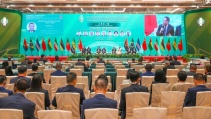
More than 30,000 local people and senior officials of central authorities gathered Thursday in Nanning, capital of southwest China's Guangxi Zhuang Autonomous Region, to celebrate the region's 50th founding anniversary.
Zhou Yongkang, a member of the Standing Committee of the Political Bureau of the Communist Party of China (CPC) Central Committee, gave a speech at a gathering, which was followed by a singing and dancing show.

Zhou Yongkang (front), member of the Standing Committee of the Political Bureau of the Communist Party of China (CPC) Central Committee and head of the central government delegation, addresses the celebration ceremony marking the 50th founding anniversary of the Guangxi Zhuang Autonomous Region in Nanning, capital of southwest China's Guangxi Zhuang Autonomous Region, Dec. 11, 2008. (Xinhua/Li Tao)
Zhou arrived in the regional capital on Wednesday, leading a delegation from the central government to join in the celebration.
In the speech, Zhou said the founding of Guangxi Zhuang Autonomous Region was another successful practice of China's minority autonomous system and the great progress the region achieved in the past half century proved that socialism must be relied on to make prosperity for all nationalities, Zhou said.
The central government hoped that the region's people and officials could strive for bigger development and progress in the future, he added.
The region, gateway to southeast Asia, was founded on Dec. 11, 1958. As one of China's five minority autonomous regions, it has 12 ethnic groups, including the dominant Zhuang nationality.
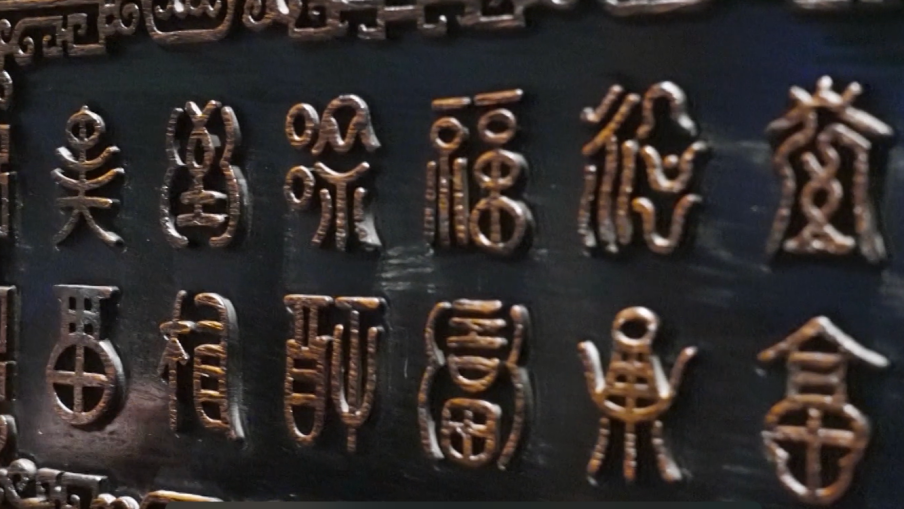
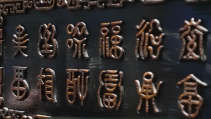
Also on Thursday, the central government delegation presented to Guangxi a bronze "ding", a ritual article since ancient times. The footed cauldron is inscribed with the characters "min zu tuan jie bao ding", which means "treasure of ethnic unity", written by President Hu Jintao.
Zhou and Guo Shengkun, secretary of the Guangxi regional Party committee, jointly unveiled the ding, whose weight - 13 tons - symbolizes 1.3 billion Chinese people.

The present from the central government symbolized prosperity, stability, ethnic unity and national unity, Ismail Tiliwaldi, vice chairman of the Standing Committee of the National People's Congress, said at the unveiling ceremony.
Zhou and the delegation members visited an exhibition showcasing achievements Guangxi has made in the past five decades. He also opened a newly-built museum of history and cultural heritage of ethnic groups in Guangxi.
In a separate ceremony on Thursday, Zhou broke ground for a project to rebuild the Xianggui railway that links central China's Hunan Province and Guangxi. The project is expected to effectively motivate the resources development and industrialization and urbanization of areas along the railway, and help with the poverty reduction and economic progress.
GUANGXI URGED TO GRASP DEVELOPMENT CHANCE
In the speech, Zhou Yongkang said the central government had announced a plan for the development of an economic zone in Beibu Bay. He urged officials of the region to implement the plan fully.
"Guangxi has unprecedented opportunities for development, and it has huge potential with its beautiful landscape, splendid culture, rich resources and geographic advantages," Zhou said, adding that the central government wants a better life for Guangxi residents.
Zhou urged the region to enhance cooperation with other areas in south China's Pan-Pearl River delta and step up construction of ports, which could be a major marine outlet for China's southwest area.
The region should also actively participate in the creation of a free trade zone between China and members of the Association of South East Asian Nations and economic cooperation in the Pan-Beibu Bay, he added.
Guangxi should take an active part in international cooperation with partners in the Mekong River sub-region, downstream of China's Lan-ts'ang Chiang, which originates in the Qinghai-Tibet Plateau, Zhou said.
The official told the region's officials to cope with the spreading international financial crisis and reduce its negative impact on the region's economy to achieve smooth growth, in line with the arrangement set by the central economic conference that concluded on Wednesday.
He asked the region to increase aid to people living in mountainous, rural and impoverished areas to achieve harmonious development.
Officials from minority groups must be cultivated and promoted especially and the right of minority groups must be safeguarded to strengthen national unity, Zhou stressed, hoping that the region could become a new economic power in the coastal region, a new base leading the development of the western region and an important international economic cooperative zone.
Vice-Premier Zhang Dejiang, who is also deputy head of the central government delegation, read out at the rally congratulatory messages from the CPC Central Committee, the Standing Committee of the National People's Congress, the State Council, the National Committee of the Chinese People's Political Consultative Conference and the Central Military Commission.
Editor: Yan
|