

















Lujiang Village

Kanglu Area
On February 2nd, the 23rd day of the twelfth lunar month, garment factory owner Zhong Xiang chose not to return home to prepare for the Chinese New Year. Instead, he arrived early at the Lujiang Village's Xintang Garment Factory in the Haizhu District, stationed at the Haizhu Investment Office, inquiring about the rental costs and preferential policies for his factory. With the approval of the Kanglu Area (Kangle and Lujiang areas) Transformation Plan, the timing and destination of relocation can no longer be ignored by garment factory owners.
"Textile industry in Guangzhou tops elsewhere in China and textile industry in Sun Yat-Sen University Textile Business District tops that in Guangzhou." Sun Yat-Sen University Textile Business District strives to become the hub of world-class textile and fashion businesses. The significant changes during this Chinese New Year leave all Guangzhou apparel professionals filled with anticipation for the future, yet there is also a hint of uncertainty.

A garment factory in the Kanglu Area
As a traditional pillar industry in Guangzhou, the textile and apparel industry is conducive to improving people's livelihoods. The Haizhu District is home to numerous fabric markets and textile business areas, with the Sun Yat-Sen University Textile Business District being the world's largest professional market for textile materials and the most crucial industry resource allocation center in China's textile and apparel industry chain.
The urban village transformation in the Kanglu area of Haizhu, Guangzhou, has initiated its"first demolition."
Within the Sun Yat-Sen University Textile Business District, there are over 60 specialized markets for textile materials of various sizes, totaling around 23,000 shops. The area accommodates nearly 16,000 merchants and enterprises, managing a diverse range of over 100,000 product categories. Over the past 30 years of development, with the Sun Yat-Sen University Fabric Market as the business center, the surrounding Kangle Area and Lujiang Area (Kanglu Area in short) have gradually become home to substantial garment factories and small workshops, involving over 2 million industry professionals.

Kanglu Area
Many young individuals come here to seek opportunities. In some "family-style" workshops, you may find a family of three working together, or the boss's siblings and distant relatives collaborating. Every year during the Chinese New Year, fathers bring their sons and bosses bring their fellow villagers into the industry. Many of them started from scratchand saved up money over the years to eventually own their factories, making Kanglu their second hometown.

A worker sewing fabric in a garment factory in the Kanglu Area
For many workers, the freelance gig model in Kanglu offers a "cost-effective" solution because it provides them with more freedom and break time. Without the constraints of clocking in and out daily as full-time workers, in Kanglu Area, they can enjoy comparable income with greater flexibility than working elsewhere.
The non-traditional "freestyle assembly" model gives full play to the clothing production model of"small order, rapid response" (which refers to a business model where individual orders have a small quantity but are processed and delivered quickly. Despite the modest order size, the products sell rapidly and the customers frequently return to place repeat orders) in Kanglu Area. The unique "Kanglu Speed," with deliveries within 24 hours, has made them the unparalleled textile villages in the national fast-fashion industry chain.
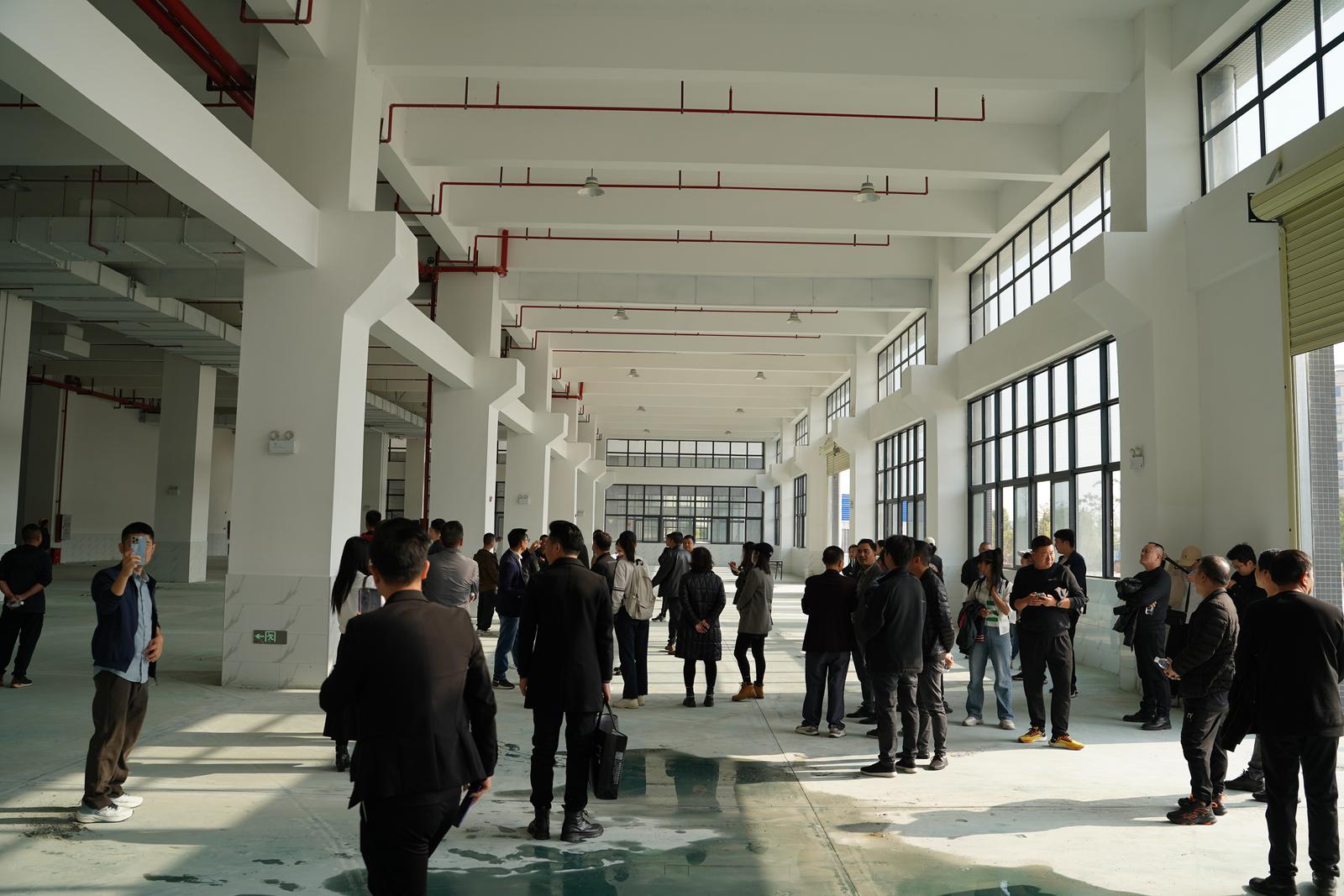
The bosses of the garment factory in the Kanglu Area came to visit the factory in Xintang Town
On the morning of December 31, 2023, a sense of transformation filled the air in Fengyang Street, Haizhu District, Guangzhou. The Kanglu area will undergo a four-phase transformation, expected to be completed in 10 years. Currently, the properties being evacuated and demolished belong to the first phase of the redevelopment. As the dismantled debris falls, the once congested roads in the Kanglu Area, crowded with electric bikes and pedestrians, are now becoming unobstructed.
Guangzhou aims to relocate "family workshop style" garment factories to an adjacent city, Qingyuan. In December 2022, Haizhu District clarified the arrangement of shifting the Sun Yat-Sen University Textile and Clothing Business District's processing and manufacturing industry to the Guangqing Economic Special Cooperation Zone, creating a "modern light textile industry cluster."
Qingyuan Industrial Park, spanning over 10,000 acres, has seen an influx of businesses, with designated areas for standard processing factories, small-order workshops, fabric production, and e-commerce centers. Covering an area of 2,000 acres, the Guangzhou North·Sun Yat-Sen University Fashion Technology City has a building area of 4 million square meters. In Qingyuan, it is the core area, the startup district and the main platform of the Guangqing Textile and Garment Industry Orderly Transfer Park. Till now, the first-phase investment attraction rate has already exceeded 80%.
At the same time, the Xintang Town in Zengcheng District, with a strong foundation in denim apparel manufacturing, also aims to accommodate the garment factories from the Kanglu Area. Since 2023, the General Manager of the Xintang Fashion and Trade City and the Guangzhou Dongdamen Industrial Co.,Ltd., has hosted hundreds of factory owners from the Lujiang area who came to inspect the factories in Xintang. Xintang is the most comprehensive and concentrated location in the entire Guangzhou garment industry chain, with over 2,000 registered clothing and related supporting enterprises, forming a well-established and extensive industrial chain.
Empowered by digital intelligence, industry upgrades are on the way.

A worker inspecting fabric at SHEIN's supplier factory.
Over the past two decades, Kanglu's unique production model has enabled rapid growth but led to missing out on the trends of Taobao-style e-commerce and SHEIN-style cross-border e-commerce. A supplier for SHEIN, with six years of experience, told the reporter that when placing an order with SHEIN, they often receive only two pictures of the garment - the front and back. The factory has to figure out the rest, including fabric selection, style design, and garment-cutting techniques. For many processing-focused small garment factories in the Kanglu Area, this proves to be challenging.

Workers sewing fabric at SHEIN's supplier factory.
Moreover, as SHEIN poses standardized requirements for suppliers, factories must have an area exceeding 2,000 square meters, making it difficult for the relatively smaller Kanglu garment factories, usually 100-200 square meters in size, to enter SHEIN's supplier queue. It becomes even more challenging for them to support orders in SHEIN, which often exceed 100,000 pieces.

Workers making jeans at SHEIN's supplier factory.
Utilizing urban renewal to drive the transition of industrial dynamics aligns with the principles of high-quality urban development. The consistently increasing urban rents favor enterprises with strong profitability and the ability to seize the high points of the industrial value chain, making them more suitable candidates for settlement. Kanglu Area, which missed the previous wave of the new economic development, now finds itself at the crossroads of industrial renewal.
The "Development Plan Outline for Sun Yat-Sen University Textile Business District" proposes that the Sun Yat-Sen University Textile Business District will leverage its traditional trading foundation, tap into the digital technology strengths of Pazhou, and the advantages of industry-university-research collaboration. It aims to explore innovative paths such as industrialization, branding, and activating consumer formats. The area seeks to transform and upgrade into the Sun Yat-Sen University Smart Fashion Innovation Port, creating an international textile and fashion business district with global fashion discourse and influence. Additionally, the Sun Yat-Sen University Textile Business District will focus on developing five major blocks: Fashion Design Pioneer Zone, Industry-University-Research Smart Manufacturing Zone, Fashion Industry Service Zone, Fashion Consumer Experience Zone, and Digital Fashion Exhibition and Trade Zone.
Source: Yangcheng Evening News