











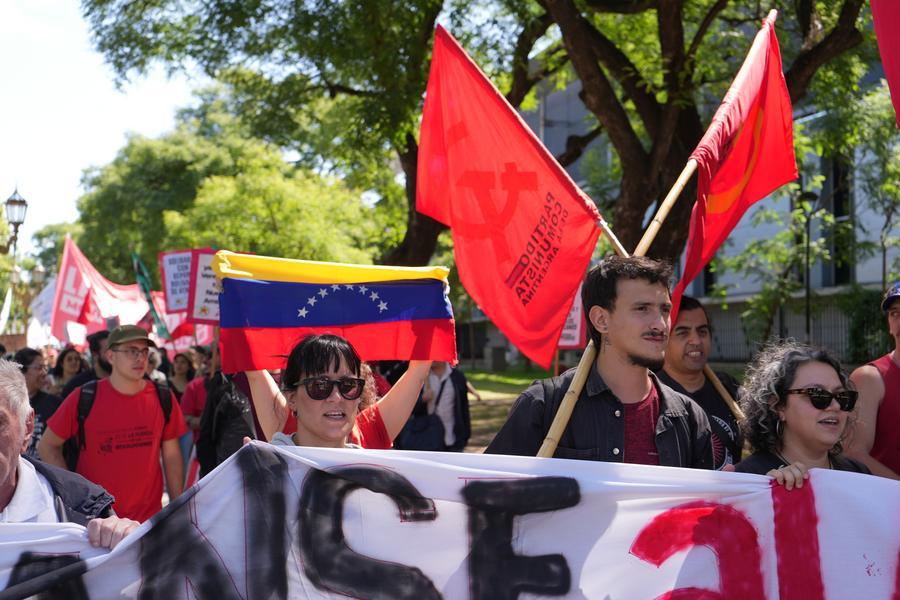
The U.S. military strike against Venezuela and capture of its president, Nicolas Maduro, has shocked the international community, triggering a steady stream of condemnation and serious concerns worldwide.
On Saturday, the United States, as said by U.S. President Donald Trump on his Truth Social, "carried out a large-scale strike against Venezuela and its leader, President Nicolas Maduro, who has been, along with his wife, captured and flown out of the Country."
He framed the military operation as one "done in conjunction with U.S. Law Enforcement."
Later at a press conference held during the day, Trump said, "We're going to run" Venezuela until a time for transition of power, but offered no timeline.
The Venezuelan side described the U.S. military operation as "brutal, unjustified and unilateral" armed attacks and a "crime of aggression" in a letter demanding a UN Security Council emergency meeting over the incident.
DANGEROUS PRECEDENT
Many countries are alarmed by the U.S. military action, as reflected in remarks by leaders of Slovakia, a member of the European Union (EU).
"Any attack on a sovereign state and its representative without a mandate from the United Nations Security Council constitutes a serious violation of international law," Slovak President Peter Pellegrini stated on social media on Saturday.
"Such actions create a precedent that may destabilize other regions of the world as well," he noted.
The U.S. military operation is further evidence of the collapse of the postwar world order, Slovak Prime Minister Robert Fico said in a social media post on Saturday.
"As the head of government of a small country, I must resolutely reject such dismantling of international law," he noted.
Such U.S. actions erode the foundations of international law and will have "serious consequences for global security, which will spare no one," French Foreign Minister Jean-Noel Barrot warned in a statement posted on his official X account on Saturday.
REGIONAL STABILITY THREATENED
In separate statements, Brazil's ruling Workers' Party on Saturday "vehemently condemns the military aggression" against Venezuela and the "kidnapping" of the Venezuelan president and his wife, while emphasizing its deep concern over regional peace and stability.
"The bombing in Caracas and the kidnapping of the president constitute the most serious international aggression recorded in South America in the 21st century," it said.
The ruling party of Brazil warned of serious risks to regional stability, with deep concern about the escalation of the conflict, which has political and economic consequences for Brazil itself, as Venezuela's neighbor, and for the region as a whole.
"Latin America must remain a zone of peace," it stressed, while urging a peaceful resolution to the existing situation within the framework of multilateral organizations, especially the United Nations, with other regional countries involved.
CALLS FOR DE-ESCALATION, RESPECT FOR VENEZUELAN PEOPLE'S RIGHTS
"Alarmed by U.S. intervention in Venezuela," UN High Commissioner for Human Rights Volker Türk urged de-escalation in a post on the social media X.
"We urge everyone to exercise restraint and fully respect the UN Charter and international human rights law. The protection of people in Venezuela is paramount and must guide any further action," he wrote.
French Foreign Minister Barrot stressed Saturday in his X post on the situation in Venezuela that "no lasting political solution can be imposed from outside and that sovereign peoples alone decide their own future."
"The upcoming transition must be peaceful, democratic, and respectful of the will of the Venezuelan people," French President Emmanuel Macron made the call in a social media post on Saturday.
Following developments in Venezuela with grave concern, the African Union (AU) said in a statement on Saturday that the 55-member continental organization "calls upon all parties concerned to exercise restraint, responsibility, and respect for international law to prevent any escalation and to preserve regional peace and stability."
Expressing its solidarity with the Venezuelan people, it emphasized that "the complex internal challenges facing Venezuela can only be sustainably addressed through inclusive political dialogue among Venezuelans themselves."