











On the coast of Naozhou Island in Zhanjiang, Guangdong—China's largest volcanic island—a heartwarming "sea turtle sanctuary" provides care for injured marine life. Here, green sea turtles with cracked shells, loggerheads with damaged flippers, and hawksbill turtles struggling to feed are treated and gradually nursed back to health.
The "chief surgeon" is local resident Liang Aizhou, whose lifelong bond with sea turtles began in 1987, when he bought and released a leatherback turtle at a local market. As rescues increased, he invested his own savings to build a specialized sanctuary with professional rescue pools. Designated the Guangdong Aquatic Wildlife Rescue and Conservation Education Base (广东省水生野生动物救护科普基地) in 2009, the center has since treated 252 injured sea turtles, along with other aquatic animals such as Chinese horseshoe crabs and Indo-Pacific humpback dolphins.
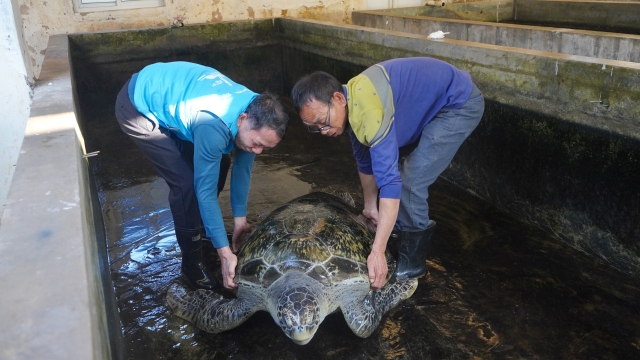
In recent years, the number of "inpatients" has dropped sharply, with only six arriving in 2025—reflecting greater awareness among local fishermen, who now often release accidentally caught turtles immediately if they appear uninjured.
Today, the center is more than a rescue station; it serves as a classroom by the sea, drawing visitors and families who come to hear the turtles' stories and witness their resilience.
Beyond sea turtles, the center collaborates with universities to breed Chinese horseshoe crabs, the "living fossils of the sea." Over the past decade, nearly ten million juvenile crabs have been returned to the ocean.
As the tides ebb and flow, this small sanctuary on the volcanic island stands as a steadfast beacon, protecting marine life and inspiring conservation in countless hearts.
Reporter | Lin Riqing
Photo & video | Wu Dongjun