











Editor's note:
In 2025, China marks the 45th anniversary of the establishment of its special economic zones (SEZs). Over four and a half decades, these zones have evolved from policy experiments into widely studied development models, reshaping cities, industries, and governance practices.
Kishore Mahbubani, Singapore's former ambassador to the United Nations (UN) and a leading scholar of global affairs, has long studied China's development path on the global stage. Describing himself as a "China optimist," he recently travelled through Guangdong Province, visiting Shenzhen and Zhuhai—two of the country's earliest SEZs—to observe how they have changed and what lessons, if any, they may offer beyond China.
Starting today, South is launching a new "Inside China" series beginning with Kishore Mahbubani's visit to Shenzhen and Zhuhai, and tracing China's development through close, on-the-ground observation.
Shenzhen recently hosted the Asia-Pacific Economic Cooperation (APEC) Informal Senior Officials' Meeting, opening the APEC "China Year". Earlier, the city was officially confirmed as the venue for the 2026 APEC Economic Leaders' Meeting.
Why Shenzhen?
Singapore's former ambassador to the UN Kishore Mahbubani, who attended the very first APEC Economic Leaders' Meeting in 1993, recently returned to the city. He approached Shenzhen, which he described as "the fastest-developing city in world history," with analytical curiosity.
"When APEC leaders come here, they'll be very impressed," Mahbubani said. "What Shenzhen has accomplished can be a real source of inspiration for the world."
BYD as a reflection of Shenzhen's wider story
From the top floor of a skyscraper overlooking Shenzhen Bay, Mahbubani pointed to the ribbon of lights across the water and asked: "That's Hong Kong (China), right?"
Fifty years ago, he stood on the Hong Kong side looking across at what is now Shenzhen. "There was nothing here," he recalled. "All I saw were rice fields, grass, and farmers." Half a century on, he added, "the skyline is comparable to that of New York."

Kishore Mahbubani looks out over Shenzhen's night skyline. (Photo: South)
Often hailed as a leading voice on Asia's rise, Mahbubani believes that at the 2026 APEC meeting, Shenzhen itself will be part of the discussion—not just as a host city, but as a reference point for development.
He argued that much of that "inspiration" lies in the city's industrial transformation. At BYD, he test-drove new vehicles and watched safety demonstrations of the company's blade battery technology, gaining first-hand insight into how a local firm has evolved from basic manufacturing to advanced engineering and design.
"I might buy a BYD as my next car," he said.
Founded as a battery maker for early mobile phones, BYD has grown over three decades into a global new-energy company operating in 116 countries and regions. For Mahbubani, its rise mirrors that of Shenzhen itself.
"BYD's story is part of the larger story of Shenzhen that I have been following," he said, "one built on innovation and determination."
This year marks the 45th anniversary of Shenzhen's designation as a SEZ. Since 1980, the city's GDP has surged from 270 million yuan (about 38.4 million US dollars) to nearly 3.7 trillion yuan (about 522.7 billion US dollars) in 2024, with an average annual growth of 18.8% in real terms.
Today, Shenzhen ranks among the largest urban economies on the Chinese mainland and is positioning itself as a model for China's modernization drive by 2035.
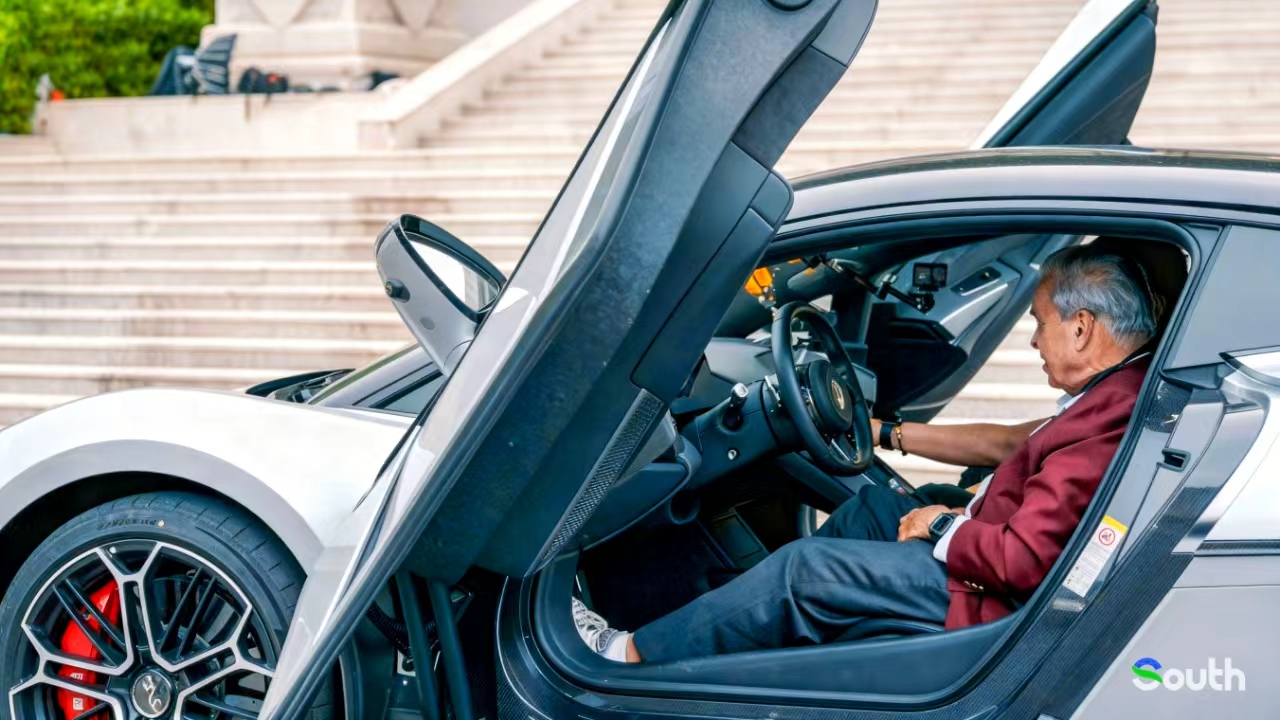
Kishore Mahbubani test-drives a new BYD model. (Photo: South)
Government coordination: a core advantage of China's SEZs
Shenzhen's appeal, Mahbubani suggested, is also institutional.
At the Qianhai Shenzhen-Hong Kong Youth Innovation and Entrepreneur Hub, he visited start-ups and spoke with Hong Kong-funded companies. Monthly rents as low as one yuan per square meter, combined with end-to-end support for entrepreneurs, left a strong impression on him.
"This may be the lowest rent in the world," he remarked. "It's impressive—and worth studying."
The Qianhai Shenzhen-Hong Kong Modern Service Industry Cooperation Zone was established in 2010 to deepen collaboration between Shenzhen and Hong Kong and to give Hong Kong more room to grow. To date, more than 10,000 Hong Kong-funded enterprises have registered there, with a combined registered capital of over 100 billion US dollars.
In Mahbubani's view, Shenzhen's 45-year development is also the story of how relations with Hong Kong have shifted—from one-directional spillover to mutual reinforcement.
At the Shenzhen Longhua International Cooperation Center, he examined how government agencies provide one-stop services to address challenges companies face from registration through expansion.
"This model has worked very well in Singapore," he noted. "And I can see it also works very well in Shenzhen."
For Mahbubani, this reflects a defining feature of China's SEZs: "It takes a whole-of-government approach. The SEZs are not just promoted by the economic agencies, but by all agencies of the government," he said. "So clearly, Shenzhen has succeeded in creating an ecosystem that is generating a lot of success stories in terms of new enterprises and new entrepreneurs."

Kishore Mahbubani visits the Qianhai Shenzhen-Hong Kong Youth Innovation and Entrepreneur Hub. (Photo: South)
An industrial ecosystem already at the global forefront
Shenzhen's vitality, in Mahbubani's view, is also evident in its openness. With an average age of just 32.5, the city is one of China's youngest. Roughly one in ten residents is an entrepreneur, and more than 90% of innovative enterprises are locally grown.
At RayNeo, Mahbubani put on AR glasses that offer real-time translation, first-person recording, and built-in AI assistance—what the company described as an extension of reality itself. Founded just three years ago, RayNeo has already secured close to 40% of the global market in its segment.
Over the past four decades, Shenzhen's industries have steadily moved up the value chain. The city is now home to more than 25,000 nationally recognized high-tech enterprises and has ranked first among Chinese cities in international patent applications for 20 consecutive years.
Later, at MixC World, Mahbubani walked through a vibrant, brightly lit commercial complex filled with international brands and flagship stores, observing the city's evening consumer activity.
"Shenzhen is an open and inclusive city," said Alanna Xu, leasing manager of Shenzhen MixC World. "We aim to create a highly innovative space for consumers here." She pointed out that 16 of the stores are regional or national firsts for their brands.
"Our performance has been robust over the past two years," Xu added. "Last year, sales reached 6.9 billion yuan (nearly one billion US dollars), and growth this year is around 25%."
The figures prompt reflection from Mahbubani. "What surprised me most," he noted, "is how advanced the industries in the Guangdong-Hong Kong-Macao Greater Bay Area have become. Clearly, in some industries, you're not following other countries. You are ahead of other countries."

Kishore Mahbubani experiences RayNeo's AR glasses. (Photo: South)
At a time when global growth is slowing, Mahbubani said Shenzhen offers a different way of thinking about development.
"The Western countries no longer seem to place progress at the center," he observes. "But 88% of the world's population lives outside the West, and they often live in poor countries."
In his view, the transformation Shenzhen has undergone over 45 years provides a visible and analysable reference point for developing countries. "What Shenzhen has accomplished can be a real source of inspiration for countries to see how much progress you can make in such a short period of time."
As night falls, the lights along Shenzhen Bay link both shores. From rice fields to a technology hub, decades of change are compressed into a single view. Mahbubani's conclusion is simple: this is where the world can find real insight into development.
Chief Planner: Zhao Yang
Editorial Coordination: Xie Miaofeng, Ouyang Yan
Project Coordination: Yuan Zixiang
Script: Liu Xiaodi, Ou Xiaoming
Director: Ou Xiaoming
On-screen & Narration: Liu Xiaodi
Cameraman: Guo Hongda
Text: Liu Xiaodi
Logistics: Guo Zedong, Jiang Junyan
Poster Design: Lai Meiya
Editor: Liu Lingzhi
With special thanks to:
Shenzhen Longhua International Cooperation Center, Qianhai Shenzhen-Hong Kong Youth Innovation and Entrepreneur Hub, Eyes of the GBA Bookstore, BYD, Shenzhen MixC World, RayNeo, Raffles Shenzhen, Shenzhen Prevision Technology Limited Co., Ltd., Inspro Science Limited, Guangzhou Tianjiang Culture Media Co., Ltd.
Also contributed by:
Pan Jiajun, Qin Shaolong, Zhan Manqi, Yang Yinan, Wu Wenhui, Zhang Mengjiao, Ouyang Zixuan, Zhang Yuetong, Peng Shengjie.