











"The problems that we are facing are global problems, and we need global solutions for global problems. Why not have APEC as a way to seek consensus, reach understanding, then use this understanding at the global level?"
The proposal was offered by Carlos Kuriyama, Director of the Policy Support Unit (PSU) at the APEC Secretariat in an exclusive interview with South after attending a seminar on "APEC 2026: Pathways to Inclusive Growth and Shared Prosperity in the Bay Areas," held by the Guangzhou Institute of the Greater Bay Area on February 5.
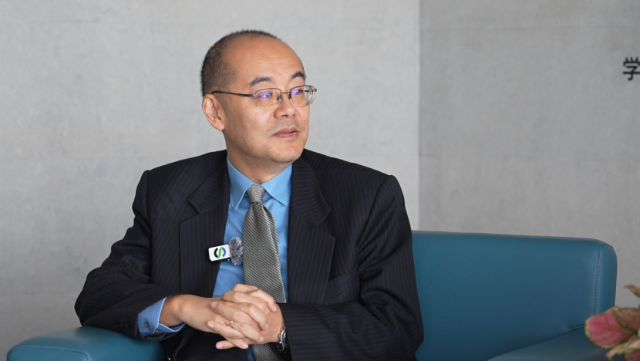
Carlos Kuriyama in an exclusive interview with South in Guangzhou on Feb. 5, 2026
A wide range of topics have been discussed in First Senior Officials' Meeting and Related Meetings
As an official of the APEC Secretariat, Kuriyama made his first visit to Guangzhou for the 10-day First Senior Officials' Meeting and Related Meetings starting from February 1.
Officials from APEC members are gathering to discuss issues related to the three priorities that China has proposed, namely, openness, innovation, and cooperation.
"The intention is to develop the agenda in a way that by the end of the year in November 2026, when APEC leaders meet in Shenzhen, we can have a substantial outcome and deliver," he said.
The leader of PSU at the APEC Secretariat heard a lot of talks and discussions when attending ad hoc meetings in the last few days, such as artificial intelligence, connectivity, etc.
Officials from APEC members attempted to use AI, as he mentioned. They discussed its applications and potential among other topics. As for connectivity, going beyond traditional physical connectivity, institutional, or people-to-people connectivity, they are also looking at digital connectivity.
Additionally, meetings unfolded on oceans and fisheries, health, and food security, as Kuriyama observed.
APEC IN CHARTS 2025, published by PSU in Guangzhou on Feb. 5, 2026
APEC aims at sustainable development, equitable growth & a strong sense of Asia-Pacific community
Working in the APEC Secretariat for over 15 years as a senior analyst and now director of the PSU, Kuriyama admitted that APEC has made a lot of progress since its founding in 1989.
As StatsAPEC published by PSU reveals, real GDP in the region surged from $18.8 trillion in 1989 with 12 founding members to $57.5 trillion in 2024 with 21 members currently, roughly accounting for 60% of the world's total.
He attributed this success to economic openness as one of the key elements.
"This has been one of the reasons why a lot of people have been able to leave poverty levels. Around one billion people have risen out of poverty since then in the APEC region," he stated.
Notably, he listed two countries—China and Peru. When China entered APEC in 1991, this process accelerated. The same trend has been happening in other APEC members, including his homeland, Peru.
APEC has been dealing with many issues at present, Kuriyama noted. "We are working a lot on trade and investment. It has been our bread and butter."
Apart from that, he introduced other domains that APEC covers, such as innovation and economic and technical cooperation, along with structural reforms to make market-based changes in policies that could help members improve economic resilience.

Panorama of Shenzhen Nanshan District (CFP Photo)
A healthy Chinese economy is crucial to the world
"To have a healthy economy here in China is very important for the world," Kuriyama underscored.
He further detailed that there are only two economies, China and the US, whose economic downturns can affect the rest of the world.
Given that 2026 marks the 35th anniversary of China's joining APEC and is designated as "APEC China Year," the APEC official hopes that China will use APEC as a way to find further reforms within critical areas.
Speaking about the Guangdong-Hong Kong-Macao Greater Bay Area (GBA), as the hub of China's advanced manufacturing, finance, and innovation, Kuriyama was impressed by its remarkable development.
During his visit to Shenzhen in December last year, he observed drones delivering food in parks and numerous autonomous vehicles commuting on the streets. Many global companies have offices in Shenzhen.
"It has developed from a fishing village to a major city interconnected with the world, attracting the best talent globally and fostering numerous new startups," Kuriyama praised.
The Greater Bay Area plays a significant role in global value chains, he noted. The seasoned APEC official hopes it can maintain that position and privilege.
Reporter | Zhang Ruijun
Cameraman | Guo Hongda
Photo | Guo Hongda, Zhang Ruijun
Script | Zhang Ruijun
Video & Poster | Guo Hongda