











On the surface of a cup of hot latte, a coffee printer is transforming a user-uploaded picture into an edible pattern, signifying Jiangmen's century-old coffee industry's silent shift from tradition to trend with the gentle hum of inkjet printing.
At a recent press conference on Jiangmen's achievements during the 14th Five-Year Plan period (2021-2025), people queued to have their chosen images printed on their coffee.
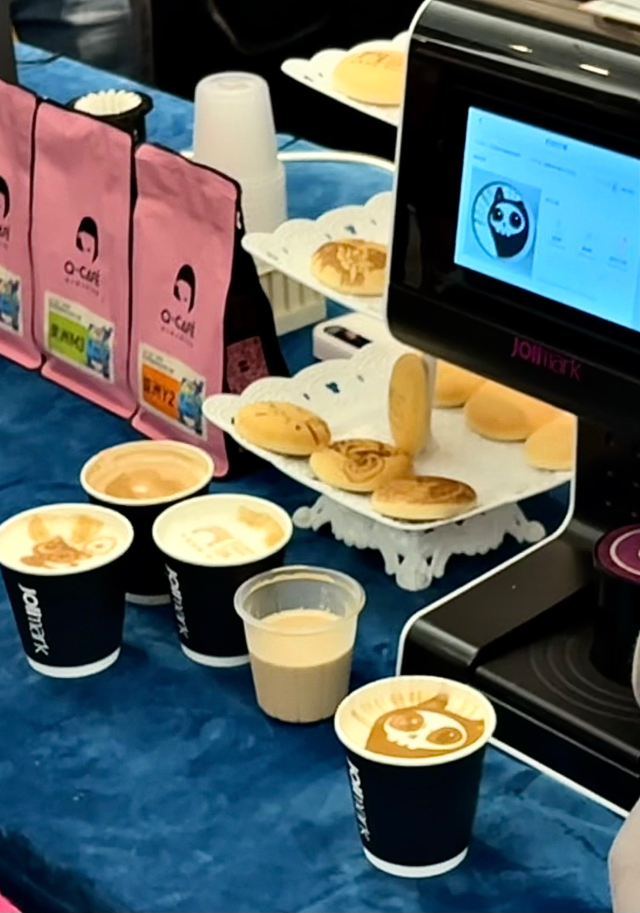
The coffee printer, the center of attention, is produced by Jiangmen's local company Jolimark, expanding the coffee production logic of the city known as China's coffee industry base.
Jiangmen's coffee industry has deep roots in its inseparable bonds with overseas Chinese, who first brought the international drink to the city 160 years ago. As the 14th Five-Year period ends, the city is now home to over 21 licensed coffee roasting enterprises with an annual production capacity exceeding 6,000 tons. Approximately 1,600 cafes are scattered across its urban and rural areas, averaging about 3.8 cafes per 10,000 people, ranking among the highest in China.

From roasting to processing, Jiangmen boasts a solid foundation of the industrial chain in the coffee sector. As the city develops, its traditional coffee industry is also absorbing new elements, catering to evolving consumer trends, especially those represented by the youth generation: characterized by uniqueness, customization, and fashionable creations.
"Drawing inspiration from Jiangmen's long history as a hometown for overseas Chinese and its coffee industry development, we have collaborated with many local coffee businesses, whose needs inspired us to develop the coffee printer," revealed Wen Zeqiang, Operations Director of Jolimark.

"Simply put, it (the coffee printer) satisfies a higher-level consumption need—customized consumption, which is also an expression of one's thoughts and personality," stated Wen Zeqiang.
Leveraging its accumulated expertise in the printing industry, Jolimark keenly identified young consumers' demand for personalized coffee and developed a coffee printer that uses food-grade ink.
This printer can transfer any image directly onto coffee foam, biscuits, or even beer froth. "Integrated with our AI functions, the coffee printer can quickly print images uploaded by users," Wen Zeqiang explained.

"Our coffee printers are now particularly popular at festival celebration venues or places where young people gather, like anime conventions or university campuses," shared Wen Zeqiang.
This technology transforms simple coffee consumption into a vehicle for social sharing and personal expression. "Many people want to print their own creations; that reflects the underlying consumption need—the demand for personalization," observed Wen Zeqiang.
This shift in consumer psychology aligns completely with the trend of Jiangmen's coffee industry transitioning from scale to individuality. In Jiangmen, a 20% year-on-year increase is seen in newly registered coffee businesses in 2024, with establishments focusing on personalization and creativity experiencing the most significant growth, a prominent consumption trend that coffee printing technology addresses.
In Wen Zeqiang's view, the potential of coffee printing extends far beyond single transactions to the currently heated and much-focused IP economics. "Looking ahead, we plan to integrate cultural, creative, and IP-based approaches, moving beyond just the printing function to stimulate continuous demand from consumers."
He sketched an appealing scenario: for example, launching a Guochao (China-chic) cultural creation series, allowing consumers to regularly print specific patterns on their coffee, or adopting a blind box model similar to Pop Mart. "We could be the 'Pop Mart' within the coffee industry."
With a coffee adorned with self-designed images, the coffee printer is a microcosm of the multiple upgrades happening within Jiangmen's coffee industry. The personalization gene, nurtured from the sound coffee industrial base, is in turn one of the forces propelling the industry's future development.
Within the city's planned 93-hectare specialized coffee industrial park, more companies like Jolimark are now exploring cross-border integrations of Jiangmen coffee with technology and cultural creation. As the industrial blueprint for the 15th Five-Year Plan period (2026-2030) begins to unfold, the aroma of Jiangmen coffee is already reaching further into the Guangdong-Hong Kong-Macao Greater Bay Area (GBA) and beyond.
Reporter | Guo Chuhua
Photo | Guo Chuhua
Editor | Hu Nan, James Campion, Shen He