











With the upcoming opening of key sections of the Guangzhou-Zhanjiang High-Speed Railway (HSR), several new stations are set to commence operations. These stations are not just transport hubs but also architectural landmarks reflecting the unique cultural and geographical identities of their locations.
The 401-km line, designed for speeds of 350 km/h, will initially open seven new stations: Xinxing South (in Yunfu), Yangchun East and Yangjiang North (in Yangjiang), Mata and Maoming South (in Maoming), Wuchuan and Zhanjiang North (in Zhanjiang), connecting to Guangzhou Baiyun Station at one end and Zhanjiang North Station at the other.
Here's a closer look at some of the standout new gateways:
Zhanjiang North Station: A blossoming regional hub
Positioned as the largest HSR hub in western Guangdong and a comprehensive national transport gateway, Zhanjiang North Station is located about 10 km from the city center. Its vast terminal building covers 105,000 square meters, accommodates 5,000 waiting passengers, and features a 6-platform, 12-track layout. It will serve as the terminus for the Guangzhou-Zhanjiang HSR and the future starting point for the Zhanjiang-Haikou HSR.
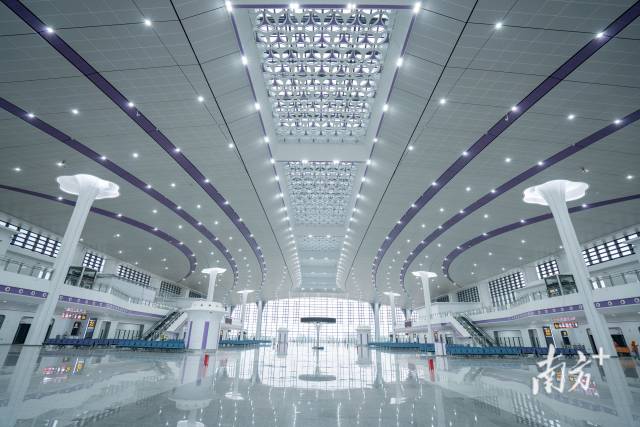
The station's design draws deeply from the cultural symbolism of the city flower, the Bauhinia. The roof resembles soft, unfolding petals, while eight facade columns echo budding flower branches. An interior color scheme of wisteria purple flows throughout the passenger areas.
A notable feature is a hundred-meter-long digital mural in the concourse, blending traditional ink painting techniques with modern technology to depict the skyline of Donghai Island's Longhaitian Beach. The ceiling design incorporates curved purple lines, symbolizing the unique confluence of the Qiongzhou Strait and the Beibu Gulf. Cultural walls showcase local arts like Yue Opera, Zhanjiang Nuo dance, and Leizhou stone dogs.
Maoming South Station: Riding the waves
As a future core passenger hub for Maoming city, Maoming South Station's design theme is "Sunrise over the South Sea, Pearl of Maritime Charm." Its architecture takes inspiration from the waves of the South China Sea, featuring a sleek, dynamic silhouette that symbolizes the city's forward momentum.
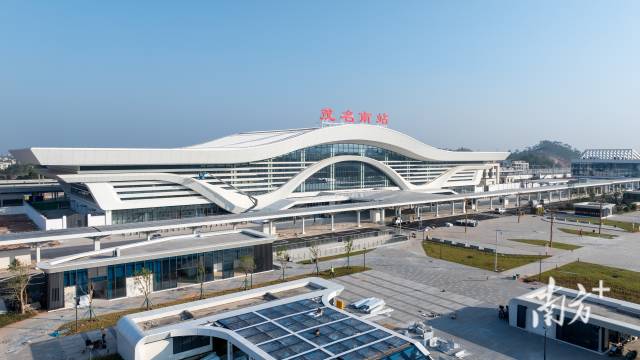
The facade features ribbon-like elements that twist and turn, creating a sense of floating lightness. Inside the waiting hall, the ceiling design forms a woven texture through interlaced curves, reminiscent of sun rays and fishing nets, nodding to Maoming's status as home to Guangdong's largest fishing port.
Yangjiang North Station: Dramatically shortened travel times
The opening of Yangjiang North Station is set to revolutionize travel, cutting the journey time from Yangjiang to central Guangzhou to about one hour and to Zhanjiang to approximately half an hour. This dramatically shrinks the spatial-temporal distance between western Guangdong and the core cities of the Pearl River Delta.
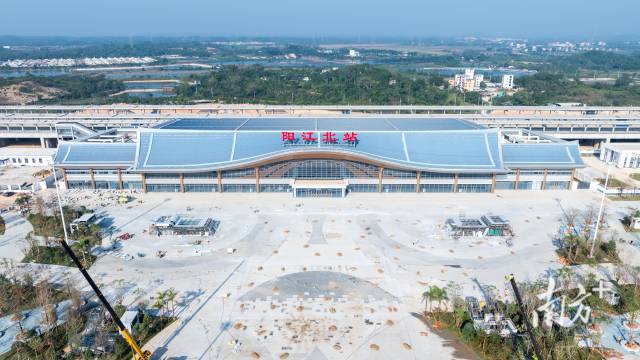
With a floor area of 16,000 square meters and a layout of 3 platforms and 7 tracks, the station's design draws inspiration from Yangjiang's distinctive coastal culture, using modern architecture to express this inclusive spirit and unique Lingnan cultural sentiment. Its opening is expected to significantly boost regional tourism, facilitating easy weekend getaways for Greater Bay Area residents to attractions like Hailing Island and Yangchun Lingxiao Cave.
Other notable stations:
Yangchun East Station: Its design is inspired by the local karst landscape and the winding Moyang River. A flowing, three-arch continuous curved roof simulates the river, while graduated horizontal sunshade louvers on the facade resemble layered ridges.
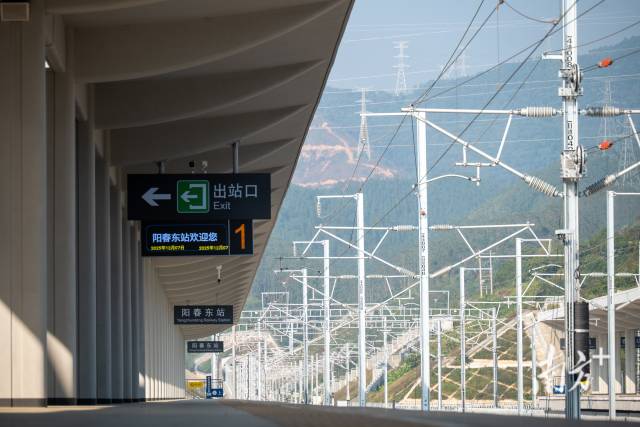
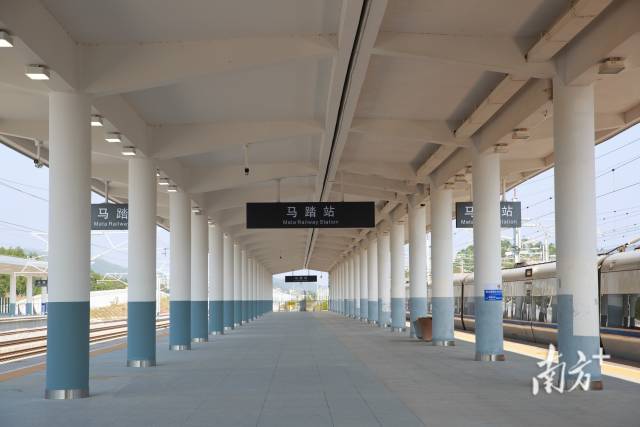
Mata Station: Embracing the legend of its name "Horse Treading", the station's design concept is "A celestial horse gallops, leaving its imprint." The forward-thrusting roof and dynamic lines on the facade simulate a flying horse, emphasizing the speed of rail travel.
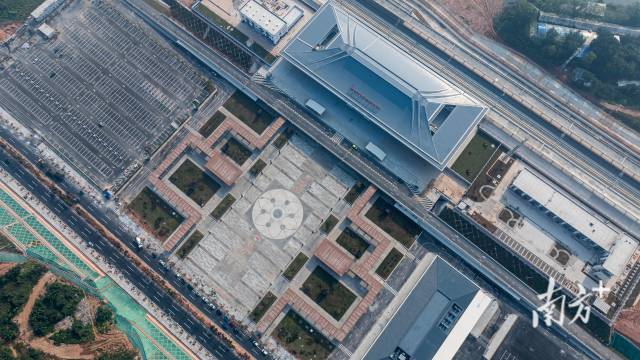
Xinxing South Station: The station building combines traditional Lingnan and Cantonese architectural forms, featuring a warm gray aluminum curtain wall, a Tang-style roof ridge, and details like imitation wood grilles and relief carvings that incorporate Cantonese cultural elements.
The introduction of these culturally infused stations marks a significant step in enhancing regional connectivity, optimizing the railway network layout in western Guangdong, and promoting integrated development within the Guangdong-Hong Kong-Macao Greater Bay Area.
Author | Jiang Chang
Photo | Nanfang Plus
Editor | Wei Shen, James Campion, Shen He