











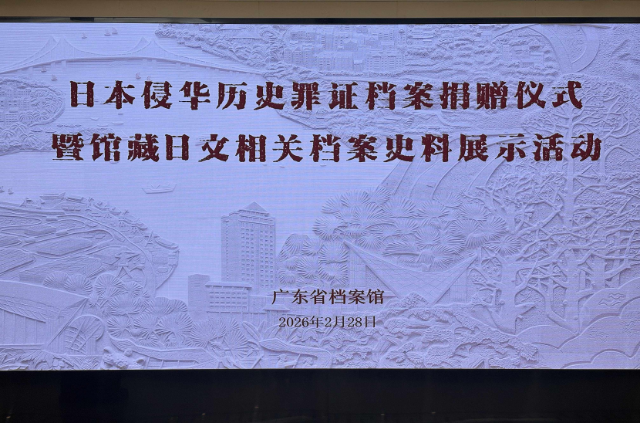
A ceremony for donation of archival materials documenting Japanese aggression against China, along with an exhibition of related archives from the Guangdong Provincial Archives, is held on Feb. 28, 2026 in Guangzhou.
A ceremony for the donation of archival materials documenting Japanese aggression against China, along with an exhibition of related archives from the Guangdong Provincial Archives, was held on Feb. 28 in Guangzhou.
In his opening remarks, Li Junxiao, Director of the Guangdong Provincial Archives, highlighted the erroneous statements on China's Taiwan made by Japanese Prime Minister Sanae Takaichi and other political figures.
Given the current situation, the event was timely and of profound significance. It showcased the donation of a batch of archival materials from three donors, which documente the crimes committed by the Japanese army in South China during World War II. It also displayed a newly acquired set of archives related to the historical crimes perpetrated by the Japanese army during its aggression against China.
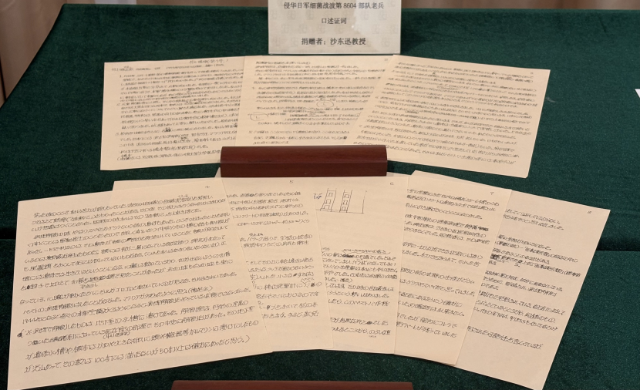
Oral testimonies from veterans of the Japanese Army's Bacteriological Warfare Unit 8604 donated by Sha Dongxun are on display on Feb. 28, 2026 in Guangzhou.
After the event, one of the donors, 87-year-old Sha Dongxun, a research fellow at the Guangdong Academy of Social Sciences, introduced his donation, which included the earliest Japanese materials exposing the Japanese army's bacteriological warfare crimes in Guangdong.
"We are not eyewitnesses. What we say is meaningless. The eyewitnesses who speak out have the evidence, and they consented to sign it. These are very precious materials that cannot be falsified. I hope these materials can be made public," Sha told reporters.
He emphasized the importance of donating these materials to the archives, as they had been preserved for a long time. Maintaining them is a matter of safeguarding China's national interests by using authentic materials to expose the crimes of the Japanese army.

Wu Peijun (L) donates archives to Li Junxiao (R), Director of the Guangdong Provincial Archives, on Feb. 28, 2026 in Guangzhou.
The archives donated by Wu Peijun, a professor at the School of Foreign Studies at South China Normal University, included two original handwritten letters sent back to Japan by Japanese soldier Saitou Katsuyuki who invaded South China, bearing the Japanese military postmarks.
Wu explained that Saitou Katsuyuki was a soldier in a Japanese unit stationed in Guangdong, where there was a Japanese airbase. He inferred that Saitou may have belonged to the ground crew or perhaps served as a bombardier or machine gunner on bombers.
"He had been stationed near Guangdong for more than two years, and the letters contain a lot of key information about the aircraft and the airport," Wu added.
Notably, Wu pointed out that Saitou also participated in a series of activities by the Japanese army to establish Japanese language schools in Guangdong for colonial education.
"From this, we can see that Japan not only carried out military aggression but also cultural and educational aggression, attempting to enslave the Chinese people and erode our will to resist. We can also see the deeper conspiracy of Japanese aggression," he noted.

Liu Changyan shows his donated historical photos to the South reporter on Feb. 28, 2026 in Guangzhou.
Additionally, Liu Changyan, a teacher at Jinshan Experimental School in Jinwan District, Zhuhai, and his team donated historical photos depicting the Japanese army's burning, killing, and looting during their invasion of Zhuhai. These photos were left by survivors of the local refugee camp, along with a video of a descendant of a massacre survivor recounting his painful experience of discovering a mass grave after the victory of the war of resistance against Japanese aggression.
In his remarks, Xiao Zili, a professor at the South China War of Resistance against Japanese Aggression History Research Center, commented that the donated archives from the three donors were "of great significance."
"They will not only directly contribute to our future research on the history of Japanese aggression against China and Guangdong, but also expose the crimes of Japanese imperialism to the public and the world," he noted.
Correspondingly, the Guangdong Provincial Archives displayed a newly acquired batch of archives related to the crimes committed by the Japanese army during its aggression against China.
These included original photographs taken by a war photographer serving with the 21st Army in South China, documenting the atrocities, as well as Japanese-language publications and photo albums reporting on the war.
Wang Han, Deputy Director of the Collection Department of the Guangdong Provincial Archives, told reporters that given Japan's current domestic policies, they feel it's necessary to clarify the truth of this history to the world. This allows more people, especially those who did not experience the war, to understand the cruelty of war and the shame and inhumanity of aggression.
"This will awaken more people, including peace-loving individuals in Japan, to oppose war and aggression and prevent Japanese right-wing forces from repeating the old path of militarism," Wang added.
Reporter | Zhang Ruijun
Photo | Zhang Ruijun