








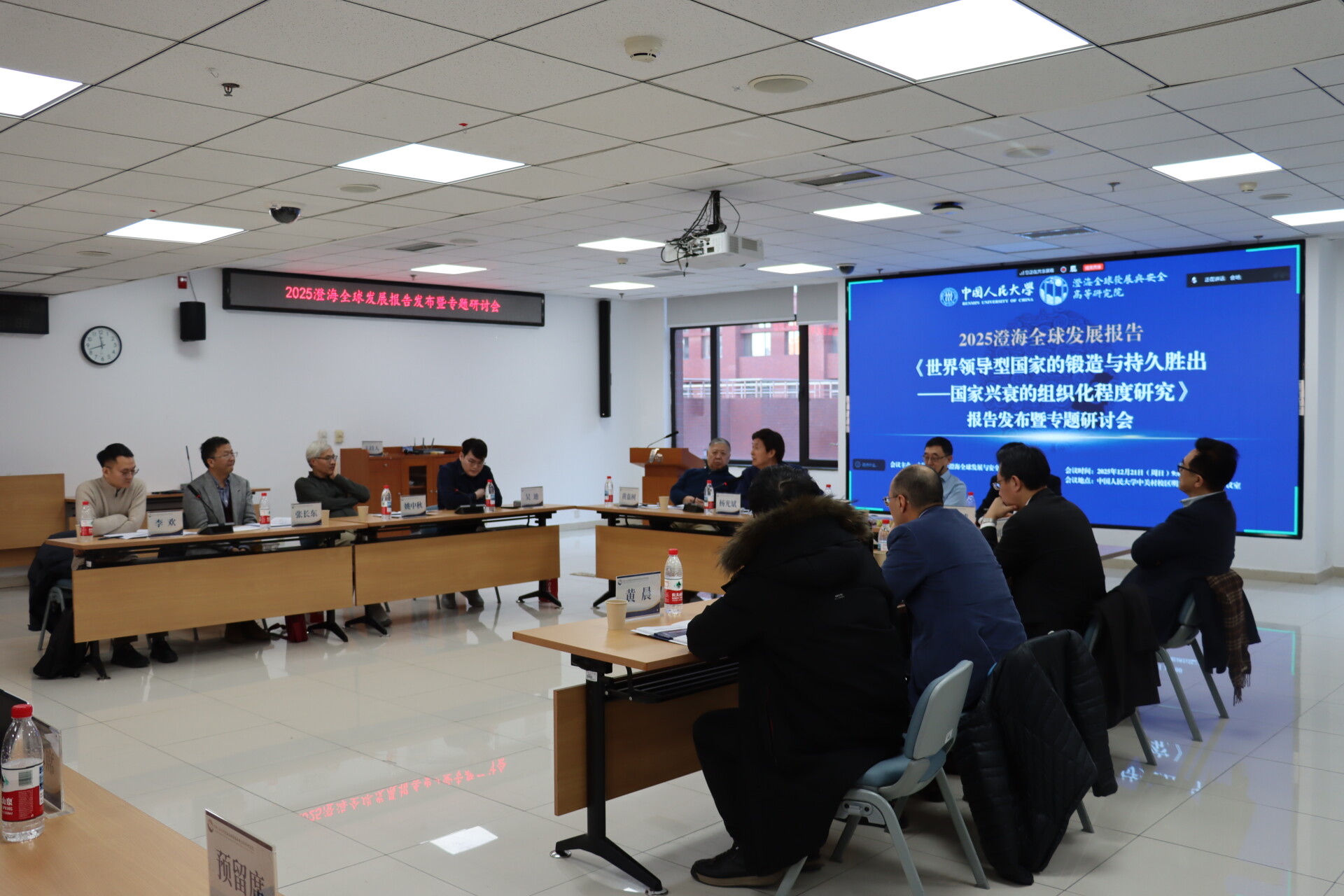
The 2025 Chenghai Global Development Report is released on December 21, 2025, by the Chenghai Institute of Global Development and Security at Renmin University of China in Beijing, China. (Photo: Chenghai Institute of Global Development and Security)
A group of Chinese and international scholars recently gathered in Beijing for the release of the 2025 Chenghai Global Development Report, debating whether the fate of major powers is shaped less by ideology or formal institutions than by how effectively states organize themselves.
The report was released by the Chenghai Institute of Global Development and Security at Renmin University of China (RUC). Titled 2025 Development Report:
Forging and Sustaining World Leadership: Degree of Organization in National Rise and Decline, it draws on long-term historical comparisons between China, Europe, and other regions to challenge explanations centered on culture or political systems.
Instead, it focuses on how states mobilize resources, coordinate society, and adapt organizational structures over time, proposing "organizational capacity" as a more neutral and operational framework for cross-national comparison.
Yang Guangbin, dean of RUC's School of International Studies, head of its Chenghai Institute of Global Development and Security, and the report's lead author, said traditional institutionalist theories struggle to explain why similar political systems produce different outcomes across periods. Institutions, he argued, tend to be stable, while organizational forms are more flexible and responsive to social change. "That is where governance actually succeeds or fails," he said.
The report's conclusions are deliberately ambivalent. High levels of organization can generate what it terms "organizational dividends", enabling early state-building, efficient mobilization, and sustained development. However, excessive coordination and path dependence may also create "organizational traps," in which administrative density and rigidity undermine innovation and adaptability.
Historical cases cited suggest that China benefited from early centralization in the pre-modern era, while Europe lagged behind until the emergence of fiscal-military states. In the modern period, however, European powers gained new organizational advantages through war-making, capital mobilization, and bureaucratic reform, reshaping global power dynamics.
Not all participants were convinced that the concept could bear such explanatory weight. Several scholars cautioned against replacing one single-factor framework with another.
Huang Jiashu, an emeritus professor at RUC, argued that national rise and decline cannot be reduced to organizational capacity alone, stressing the need to account for political, economic, ideological, and military factors.
The debate also extended to the relationship between capital and power. Huang Jing, a special-term professor at Shanghai International Studies University, contrasted societies where capital constrains political authority with those where the state guides capital, arguing that each faces distinct risks — instability in one case, rigidity in the other. The challenge, he said, lies in balancing coordination with social mobility.
Despite disagreements, there was a broad consensus that organizational capacity offers a useful lens for rethinking long-term global competition.
In an era of sustained, largely non-military rivalry among major powers, several participants argued that domestic governance structures may matter more than ideology or battlefield strength.
Summing up the discussion, Yang said the report was intended not as a blueprint but as an invitation to debate. History, he argued, shows no permanently optimal form of organization — only arrangements shaped by specific times and conditions.
Reporter | Liu Xiaodi, Rong Miaotong (intern)
Editor | Yuan Zixiang, James Campion, Shen He