











In Shantou, a coastal city in eastern Guangdong, the arrival of spring brings more than just new growth. It also draws attention to what already stands.


The city is home to 1,222 officially registered ancient trees, according to local forestry records. Among them, 114 are classified as first-grade, meaning they exceed 300 years in age. These trees are scattered across Shantou's urban and rural landscape. They stand in temple courtyards, village squares, and mountain groves. Their canopies have shaded generations.
Preservation efforts have expanded in recent years. All 1,222 registered trees have been surveyed, documented, and fitted with protective plaques. Municipal authorities have developed management guidelines and carried out restoration work on damaged specimens.
Shantou's education department has launched a series of programs linking schools with ancient trees. Lessons are now conducted beneath the canopies, with students learning about local history, ecology, and conservation. Eight such "lessons under the ancient tree" have been held across the city, at sites including a banyan in Haojiang district associated with overseas Chinese history and a tree on Nan'ao island linked to the Ming dynasty general Zheng Chenggong.
In a city built on alluvial soil near the sea, where high salinity makes growth difficult and urban development is barely two centuries old, ancient trees are rare.

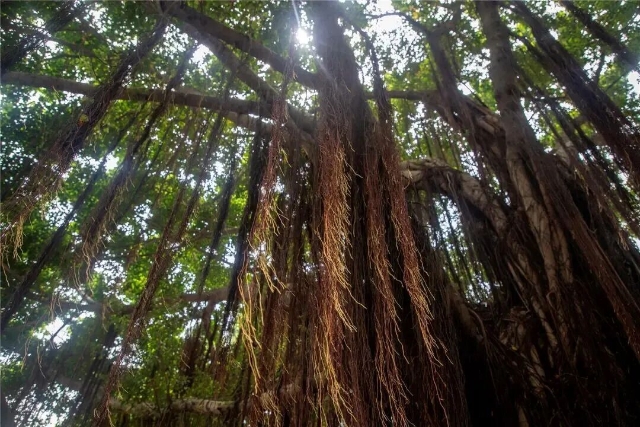
Among the most remarkable specimens:
At Xiyan Temple in Chaoyang district, a bishop wood tree (Bischofia javanica) towers over the grounds. Local tradition holds that it was planted by the Tang dynasty monk Dadian, the temple's founder. Estimated to be more than 1,200 years old it is the oldest known tree in the city.
On Nan'ao Island, in Houhuayuan village, a natural community of Phoebe zhennan trees thrives. At its center stands a 300-year-old mother tree. From this specimen, local growers have cultivated more than two million seedlings, supplying reforestation efforts across the island.
In Lianhua town, Chenghai district, ancient banyans define public space. At Xiazai village, three banyans with a combined age exceeding 1,000 years form a natural gateway. Their aerial roots have been reinforced with artificial supports, creating what locals call the "Xiazhai Ancient Banyan Gate." Beneath the canopy, residents gather on benches to talk.
Nearby, at Bisha village, five banyans grow close together, their canopies merging into a single expanse of shade. Known locally as the "Five Banyans," they were planted during the Southern Song dynasty (1127-1279) by the village's founding families, positioned according to the five elements of feng shui. They remain a focal point of village life.
For the communities that gather beneath them, these trees are simply there: silent, constant, rooted in place as the city grows up around them.
Author | Feng Huiting
Photo | Shantou Fabu