











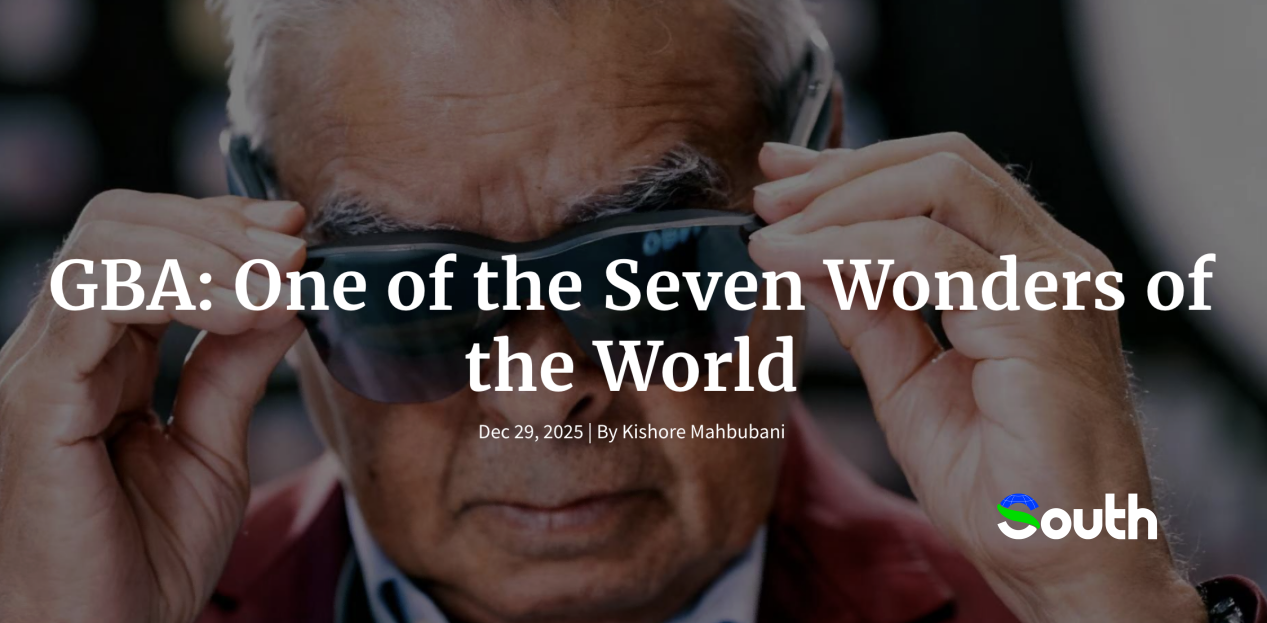
On December 29, world-renowned scholar and former Singaporean Ambassador to the United Nations, Kishore Mahbubani, published an article on his official website titled "GBA: One of the Seven Wonders of the World," reviewing his recent trip to Guangdong.
In the autumn of 2025, Mahbubani visited two Special Economic Zones (SEZs) of Guangdong Province in China—Shenzhen and Zhuhai, to observe their economic development, industrial innovation, and urban vitality. South's "Inside China" series offered a holistic record of his trip and published a series of reports.
In his article, Mahbubani stated that he first visited Shenzhen in 1975 and returned back in 2025, followed by a research trip to Zhuhai. He was amazed by the remarkable development of these two cities and believes that the Guangdong-Hong Kong-Macao Greater Bay Area (GBA), to which Shenzhen and Zhuhai belong, should be declared as one of the Seven Wonders of the World.
At the end of the article, Mahbubani highlighted that the spectacular development of the SEZs in the GBA is not just a material success story. It is also a human story about the tremendous resolve and determination of the early policymakers.
Attached is the full article by Kishore Mahbubani
GBA: One of the Seven Wonders of the World
Dec 29, 2025 | By Kishore Mahbubani
I first saw Shenzhen in 1975. I have seen it again several times, including most recently in November 2025, fifty years later. What an amazing transformation I have witnessed with my own eyes. This is why I believe Shenzhen, Zhuhai, and the Guangdong-Hong Kong-Macao Greater Bay Area (GBA) should be declared one of the seven wonders of the world.
It's not often that we recall vividly what we saw with our own eyes after fifty years. Yet I do remember visiting the border between Hong Kong and Shenzhen so that I could at least have a glimpse of the Chinese mainland that I had not yet visited then. I recall clearly what I saw: rice fields, a lot of greenery, and a farmer or two. I don't recall seeing any concrete buildings.
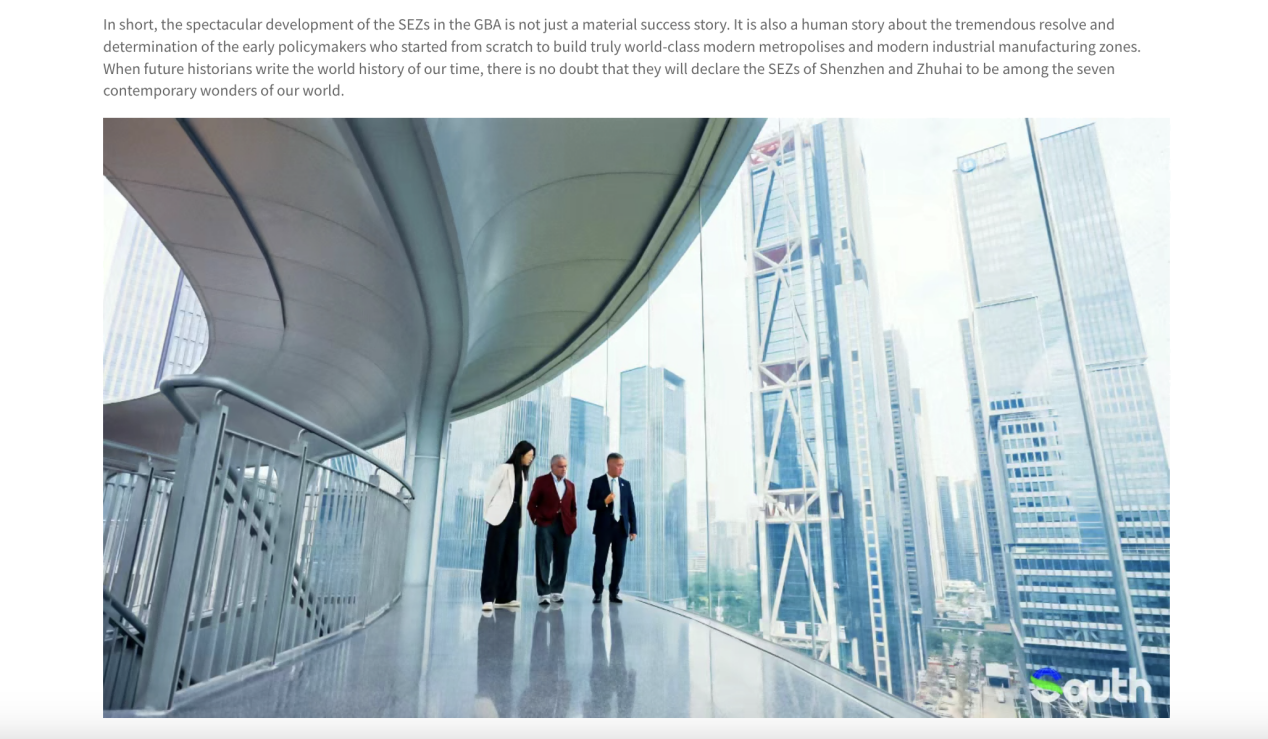
When I returned in 2025, I didn't see any rice fields or farmers. Instead, I saw a metropolis with a skyline comparable to that of Manhattan, New York—a city I had lived in for over ten years. Yet, while Manhattan took over a century to become a modern metropolis, Shenzhen achieved this in only three or four decades, after the famous and legendary Southern Tour by the great Chinese leader Deng Xiaoping in January 1992. During this tour, Deng Xiaoping said, "I have found that the rapid growth in the Shenzhen and Zhuhai special economic zones and some other areas has exceeded my expectations. After what I have seen, I am even more confident."
If Deng Xiaoping were alive today, he would be astonished to see the even more astounding progress the GBA has made. I was astounded too when I visited Shenzhen on 29–30 October and Zhuhai on 31 October. Shenzhen and Zhuhai are not just parts of a great urban metropolis; they are also world-class manufacturing centers with industries that are clearly among the best in the world.
BYD is one of them. Like many others, I recall what Elon Musk said about BYD in its early years. In 2011, he told Bloomberg that he did not see them as a competitor, saying, "I don't think they have a great product. I don't think it's particularly attractive. The technology is not very strong." Yet, 14 years later, BYD is now selling more cars than Tesla. It has sold more pure electric vehicles than Tesla for four quarters in a row—about 388,000 more from January to September 2025. More importantly, BYD is winning various automotive awards for the design and performance capabilities of its vehicles, including the iF Design Award and the World Urban Car award. Personally, it was a great joy to drive one of the dashing sports cars produced by BYD, as well as a regular sedan. My next car is likely to be a BYD.
It was also very exciting to visit the Tangjia Port Unmanned Aerial Vehicle Logistics Operations Base to see with my own eyes the passenger-carrying unmanned electric vertical take-off and landing (eVTOL) aircraft. I was looking forward to taking a ride in it. Unfortunately, since I am over 70 years old, I wasn't eligible to fly in it. However, my guide took a ride in it and sent me pictures from the air so that I could enjoy the ride vicariously.
I was also glad that, in addition to the more established industries, I was able to talk to two start-up representatives and experience firsthand the entrepreneurial culture that has developed in Shenzhen and Zhuhai. The first start-up was producing animal feed from insect larvae. Since we have an abundance of insects, this could prove to be a valuable new food source for humanity. The second start-up was called Prevision. It manufactures high-tech optical inspection products using AI.
In Zhuhai, I was stunned when I visited the enormous manufacturing facility of GREE. Since Singapore has a hot and humid climate, it's absolutely essential to have air conditioners. Indeed, the legendary former Prime Minister of Singapore, Mr. Lee Kuan Yew, once famously said that Singapore could not have thrived as a modern city if air conditioning had not been invented. Indeed, when the Asian Wall Street Journal asked Mr. Lee Kuan Yew in 1999 what his ideal invention might be, he quipped, "air-conditioned underwear." Since air conditioning is so critical for Singapore, I assumed that I had heard of all the globally famous air-conditioning brands. It was shocking to discover that I had not heard of GREE. I was even more shocked to learn that the main business revenue had increased from 5 billion RMB in 1999 to almost 190 billion RMB in 2024, an increase of almost 38 times in 25 years. Such growth is astounding.
While it was good to visit these individual industries in Shenzhen and Zhuhai, I also learned a lot from the discussion I had with Professor Tao Yitao. She has been studying the explosive growth of the Special Economic Zones in the Greater Bay Area for several decades now. I have begun reading her book entitled "Special Economic Zones and China's Development Path." She has done the world a huge favor by co-authoring this book, as it provides many practical lessons for policymakers around the world as they try to replicate China's enormously successful experience with Special Economic Zones (SEZs). I am impressed that she did not just emphasize the material dimensions of the development of SEZs. She also highlighted the cultural dimension when she said, "Culture and mindset cannot directly change society, but they can change the people, and the people can bring about changes in society" (page ix).
In short, the spectacular development of the SEZs in the GBA is not just a material success story. It is also a human story about the tremendous resolve and determination of the early policymakers who started from scratch to build truly world-class modern metropolises and modern industrial manufacturing zones. When future historians write the world history of our time, there is no doubt that they will declare the SEZs of Shenzhen and Zhuhai to be among the seven contemporary wonders of our world.
Reporter: Zhang Ruijun, Liu Xiaodi
Editor: Yuan Zixiang, Shen He