











The Australian red-claw crayfish has entered its harvest season in southern China, where it is a larger and higher-priced species. Boasting a unique bluish-green metallic sheen on its shell, it is considered one of the most valuable freshwater crayfish species in commercial farming.

A local farmer
Introduced to China from Australia in the 1990s, the Australian red-claw crayfish is now being farmed on a large scale beneath photovoltaic panels in Potou, Zhanjiang, allowing farming and power generation to share the same land.
"With its naturally iridescent shell, it clearly outgrows the common red swamp crayfish," said He Denan, a local farmer.
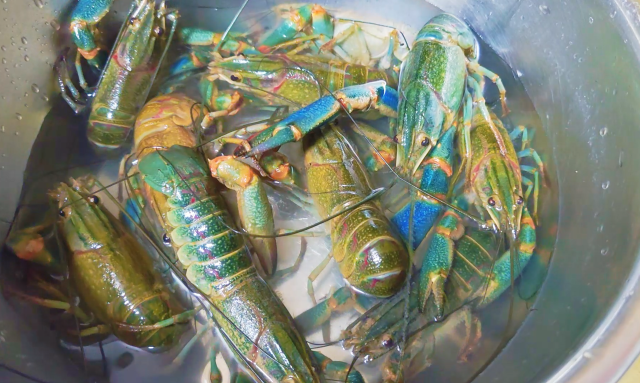
The Australian red-claw crayfish
Native to the tropical regions of northern Australia, the Australian red-claw crayfish is scientifically named Cherax quadricarinatus. While both are freshwater crayfish, it is a different species from the red swamp crayfish (Procambarus clarkii) found in China.

Farmer harvests crayfish.
Thanks to its significantly larger size and higher meat yield, the Australian red-claw crayfish has firmly established a foothold in the high-end market. Adult individuals can easily grow to over 20 centimeters long, with thin shells, plump meat, and rich, full roe.
The crayfish has a maturation cycle of approximately six months, with a per-mu (1 mu=666.67 square meters) yield exceeding 500 jin (250 kilograms).
This dual-purpose land use model has doubled the economic benefits. A representative of the Potou Photovoltaic Power Station pointed out, "Generating electricity above and farming crayfish below significantly improves land utilization efficiency."
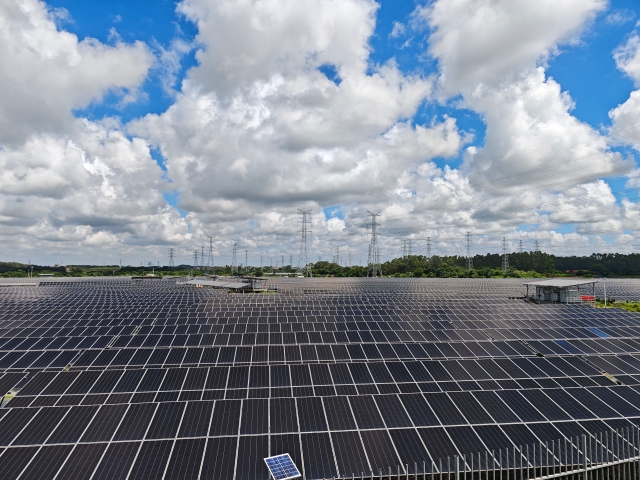
Photovoltaic power station
This innovative farming model not only enhances the overall benefits of the land but also paves a new path that balances ecological and economic returns for the sustainable development of the Australian red-claw crayfish industry.
Author: Zhou Mengya
Photo: Zhou Mengya
Editor: Huang Qini, James Campion, Shen He