











Chinese and international scholars recently convened at Renmin University of China (RUC) in Beijing for the release of the 2025 Chenghai Global Security Report, discussing the security implications of China's decade-long push to become a manufacturing powerhouse and its impact on national competitiveness and resilience.
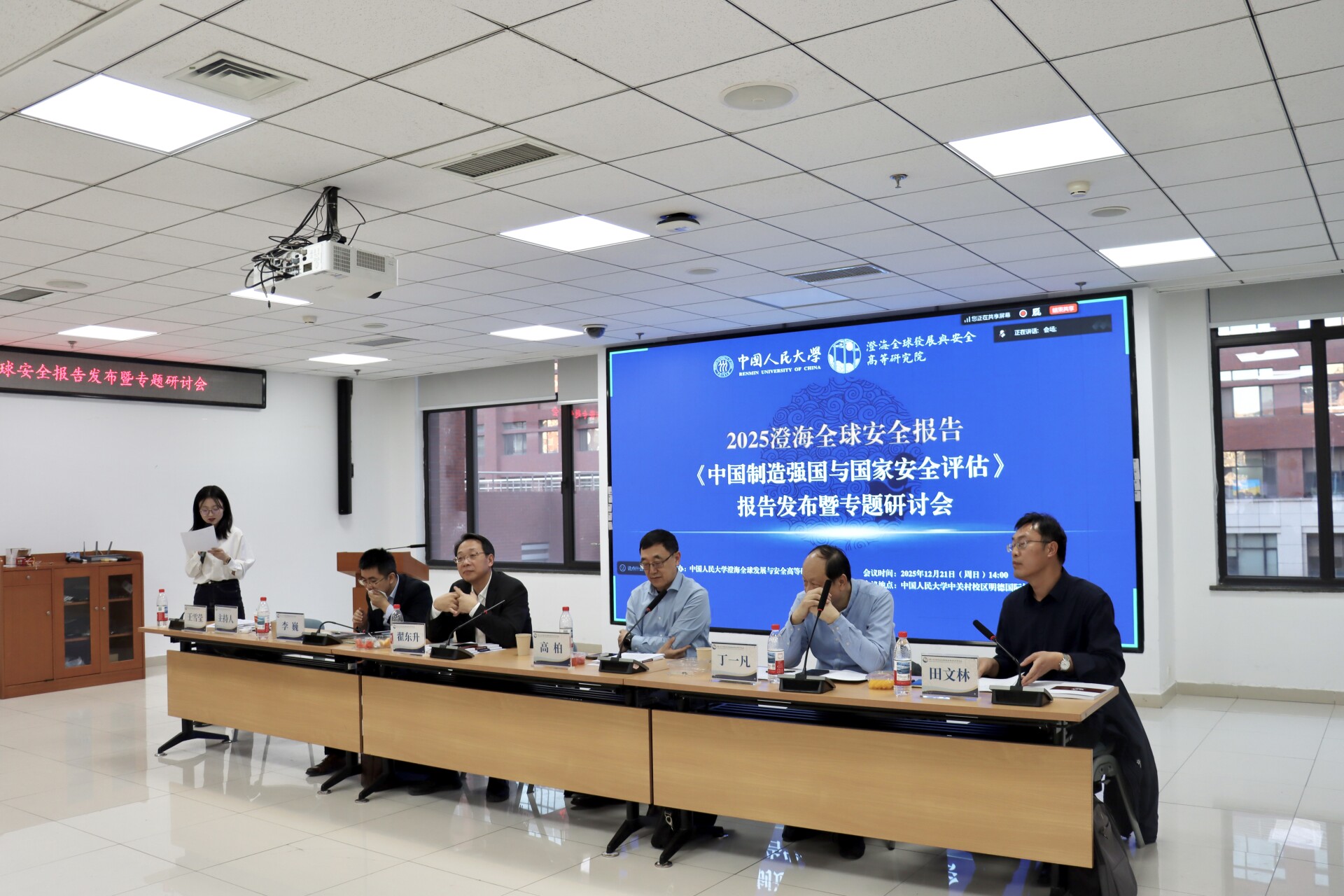
The 2025 Security Report: Assessment of China's Manufacturing Power Strategy and National Security is released at Renmin University of China in Beijing on December 21, 2025. (Photo: Chenghai Institute of Global Development and Security)
The 2025 Security Report: Assessment of China's Manufacturing Power Strategy and National Security was unveiled at a seminar hosted by RUC's Chenghai Institute of Global Development and Security. The report examines how China's industrial capacity intersects with economic resilience, technological autonomy, and global security dynamics.
At the center of the discussion was what the authors describe as a global "price revolution" - China's ability to deliver higher-quality industrial goods at significantly reduced costs.
Zhai Dongsheng, vice president of the Chenghai Institute and one of the report's lead authors, argued that this phenomenon is driven by the combined forces of productivity, logistics, electricity supply, computing power, and industrial capacity.
"The price revolution driven by Chinese manufacturing offers a form of inclusive security, particularly for developing countries," Zhai said, suggesting that affordable access to industrial goods reduces economic vulnerability across the Global South.
The report contends that China's dense industrial clusters, infrastructure, and skilled labor have strengthened its security in critical areas such as technology, resources, defense, and food supply.
It also argues that external pressures - including export controls and supply-chain restrictions imposed by Western countries - have unintentionally accelerated China's industrial upgrading.
Zhai contrasted Chinese and U.S. approaches to artificial intelligence, noting that while the U.S. has prioritized frontier research, China has focused on applying AI at scale to manufacturing and industrial systems, reinforcing its production base.
Yet the report does not present a one-dimensional picture. Wang Xueying, an assistant professor at the Central University of Finance and Economics and a contributor to the study, noted that the analysis also addresses domestic strains, including employment pressure and supply-demand imbalances.
To sustain the manufacturing strategy, the report proposes measures to expand domestic demand, such as strengthening social security and exploring income-support mechanisms.
International scholars at the seminar stressed that industrial strength can generate new vulnerabilities alongside security gains. Gao Bai, a professor at Duke University, warned that improvements in industrial security may provoke a geopolitical backlash.
Ding Yifan, senior fellow at RUC's Institute of Global Governance and Development, analyzed how manufacturing strength shapes China's relations with the U.S. and Europe, arguing that the Western "de-risking" push remains, in substance, an effort to reduce reliance on Chinese supply chains.
"Security outcomes are often contradictory," Gao said. "What strengthens a country internally can simultaneously generate external tensions. Security is constructed through global interaction, not in isolation."
Reporter | Liu Xiaodi, Rong Miaotong (intern), Huang Yuhan (intern)
Editor | Yuan Zixiang, James Campion, Shen He