











Renowned global affairs scholar and former Singaporean ambassador to the United Nations Kishore Mahbubani published an article on his personal website on December 29, reflecting upon his recent trip to China's southern province of Guangdong, dubbing the Guangdong-Hong Kong-Macao Greater Bay Area (GBA) as "one of the seven wonders of the world."
Mahbubani recently visited two of China's earliest Special Economic Zones (SEZs), Shenzhen and Zhuhai, where he examined economic development, industrial upgrading, and urban vitality at close range.
His trip was covered by South's "Inside China" series, which released a series of multilingual reports between December 22 and 29, 2025. The coverage reached an audience of more than 10 million users across South's platforms.
Readers from different countries engaged actively with the reports. Some noted that Mahbubani's on-the-ground observations underscored his earlier arguments regarding China's development trajectory, while others highlighted China's rapid pace of construction and experimentation.
Several comments highlighted China's emphasis on social development and public welfare, suggesting that aspects of its approach deserved closer study elsewhere.
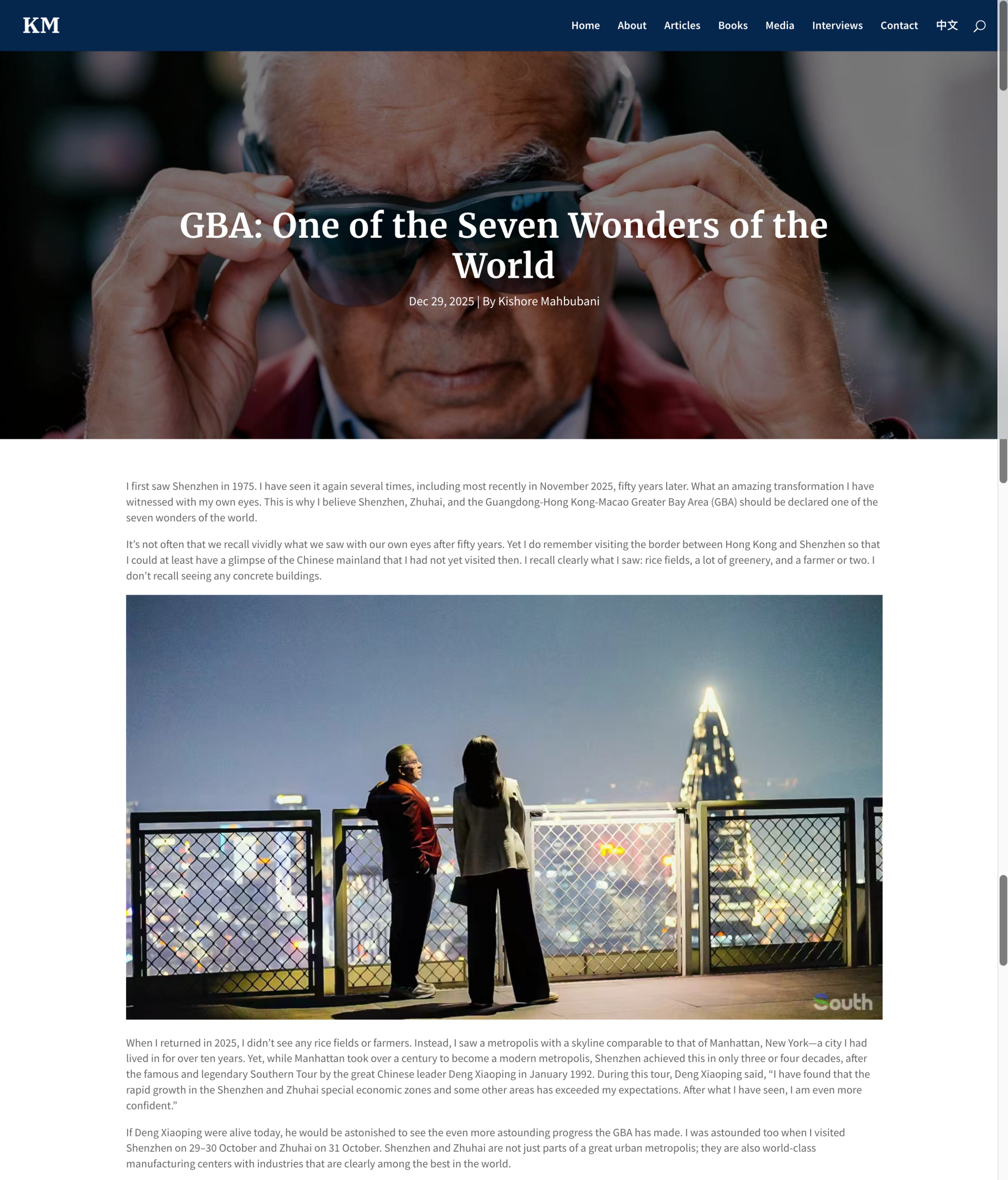
Click the picture to read the article "GBA: One of the Seven Wonders of the World" by Kishore Mahbubani
"GBA: One of the seven wonders of the world"
"When future historians write the world history of our time, there is no doubt that they will declare the SEZs of Shenzhen and Zhuhai to be among the seven contemporary wonders of our world," Mahbubani wrote in his article GBA: One of the Seven Wonders of the World.
Drawing on personal experience, Mahbubani recalled his first visit to the border between the Chinese mainland and Hong Kong in 1975, when the landscape consisted largely of farmland and scattered farmers, with no high-rise buildings in sight.
Returning in 2025, he encountered a modern metropolis whose skyline he said rivaled that of Manhattan. In his view, Shenzhen's transformation—achieved in just three to four decades—compressed a process of urbanization and industrialization that took Western cities more than a century to complete.
Mahbubani argued that Shenzhen and Zhuhai are not only integral parts of a world-class urban cluster, but have also emerged as globally competitive manufacturing and innovation hubs.
During his visit, he focused on sectors including new energy vehicles, advanced manufacturing, and the low-altitude economy, citing BYD as an example of how Chinese companies have advanced simultaneously in technology, design, and market performance, reshaping parts of the global industrial landscape.
Beyond industrial output, Mahbubani highlighted the institutional and human factors behind the success of China's SEZs. He wrote that their achievements were not the product of any single economic variable, but the result of sustained policy commitment, institutional experimentation, and broad social mobilization.
"The spectacular development of the SEZs in the GBA is not just a material success story," he wrote. "It is also a human story about the tremendous resolve and determination of the early policymakers who started from scratch to build truly world-class modern metropolises and modern industrial manufacturing zones.
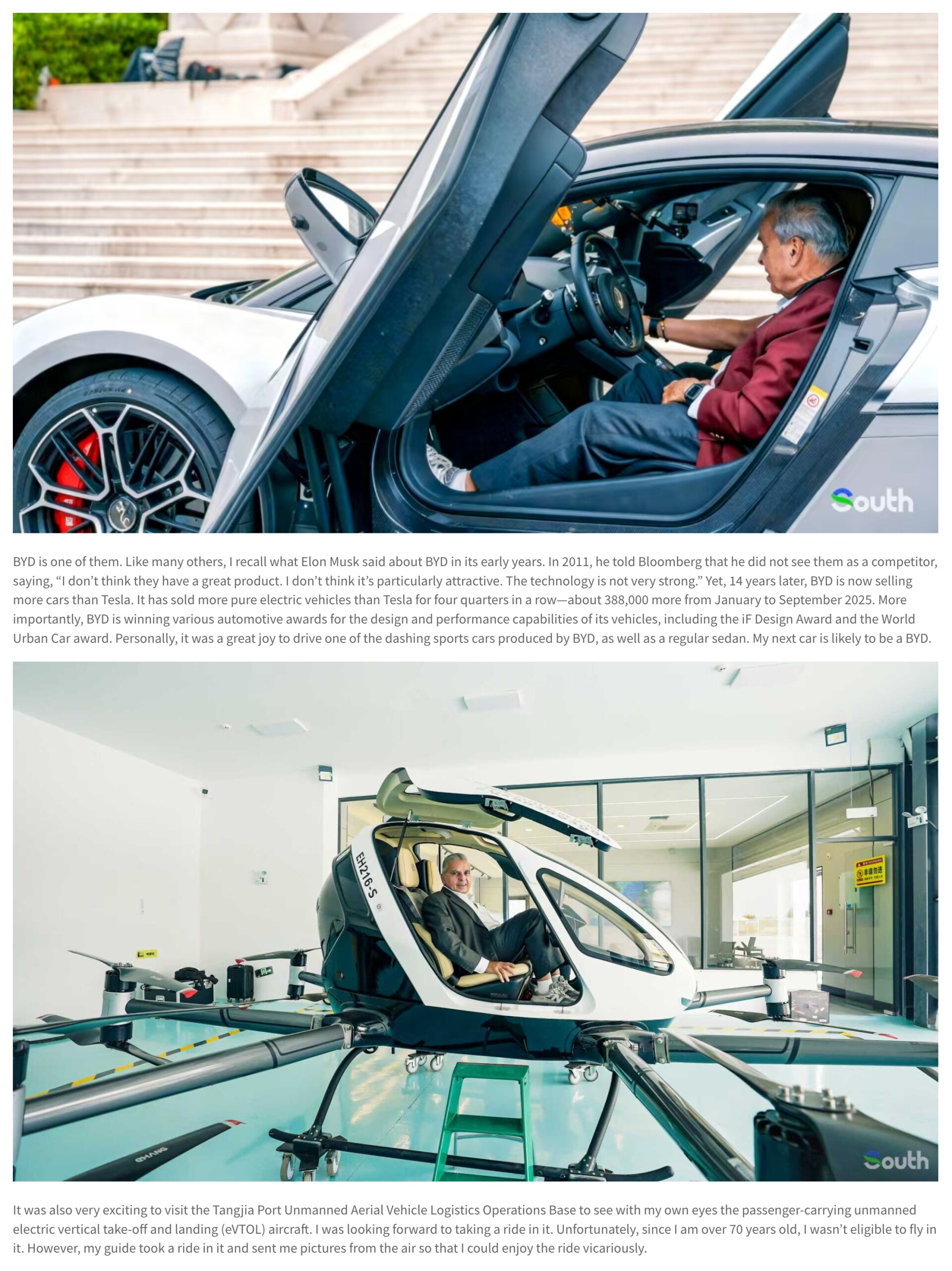
Kishore Mahbubani publishes an article on his personal website reflecting on his tour of Guangdong on December 29, 2025. (Photo: South)
"Shenzhen could inspire global development"
At the end of 2025, Shenzhen hosted the Asia-Pacific Economic Cooperation (APEC) Informal Senior Officials' Meeting, opening the APEC "China Year". Earlier, the city was officially confirmed as the venue for the 2026 APEC Economic Leaders' Meeting.
Why Shenzhen?
Mahbubani, who attended the first-ever APEC Economic Leaders' Meeting in 1993, revisited what he described as "the fastest-developing city in world history", with an analytical curiosity.
From cutting-edge technologies developed by companies such as BYD and RayNeo, to institutional innovation in the Qianhai cooperation zone linking Shenzhen and Hong Kong, and the vibrant night-time economy visible in commercial districts such as MixC World, Mahbubani said the city's economic strength and innovative capacity repeatedly stood out.
"When APEC leaders come here, they'll be very impressed," he said. "What Shenzhen has accomplished can be a real source of inspiration for the world."
The related video reports attracted wide international attention. Some viewers wrote that Mahbubani's visit to what they described as one of the world's most futuristic cities confirmed ideas he had outlined in his book The Asian 21st Century.

Others expressed admiration for China's long-term development efforts and suggested that its focus on social progress and living standards merited closer examination.


"Zhuhai reveals vision for future city"
"When I came to Zhuhai, I must say it was a mind-blowing experience," Mahbubani said, referring in particular to the city's advances in low-altitude technologies and its role in the transition from "Made in China" to "Created in China." He also observed innovation driven by deeper integration between Guangdong and Macao.
Although he has followed China's development closely for decades, Mahbubani said the scale and pace of progress he witnessed during this visit still exceeded his expectations.
He urged people from other countries to visit China themselves. "I think it's very important for the rest of the world to come in person and see what's happening here," he said. "When they go back, they'll tell people in their own countries: we must cooperate with China."
Many overseas viewers echoed this sentiment. Some commented that Zhuhai's combination of emerging industries, advanced manufacturing, and urban governance challenged their previous assumptions about Chinese cities.

Others noted that first-hand experiences often contrast sharply with second-hand portrayals of China, arguing that direct observation remains the most effective way to reduce misunderstandings and build mutual understanding.

"How China's Special Economic Zones change the game?"
During the trip, Mahbubani also held an in-depth dialogue in Shenzhen with Tao Yitao, a leading Chinese scholar on special economic zones and a senior professor at Shenzhen University. Their discussion focused on the origins, evolution, and future direction of China's SEZs.
Mahbubani raised questions about why China initially chose only a small number of locations, such as Shenzhen and Zhuhai, to establish SEZs, and how the country managed the transition from a planned economy to a socialist market economy.
Tao emphasised that SEZs were designed as institutional laboratories, tasked with exploring viable paths for systemic transformation.
She added that a key challenge today lies in aligning domestic rules more closely with international standards. In this regard, she cited Shenzhen's Qianhai zone, where regulatory coordination with Hong Kong is being advanced in areas such as finance, international arbitration, and intellectual property protection.
Summarizing the lessons of China's SEZs, Mahbubani said their success reflected both the opportunities created by globalization and China's own institutional strengths.
He pointed to advances in science and technology and large-scale poverty reduction as evidence, arguing that attempts to contain China's technological development would ultimately fail.
Mahbubani said the 45-year evolution of China's SEZs offers valuable reference points for other countries seeking their own paths to modernization. "For me, this has been a particularly meaningful journey," he said, adding that understanding what Shenzhen and China's SEZs have achieved matters not only for China but also for the wider world.
Former Pakistani prime minister's special assistant and former China-Pakistan Economic Corridor envoy Zafar Uddin Mahmood said Mahbubani's Guangdong tour resonated strongly with him.
Recalling his own years living in Guangzhou from 1976 to 1982, during which he travelled across Guangdong and witnessed its early transformation, Mahmood said the experience forged his lasting connection with the region and noted that the APEC meeting in Shenzhen will provide "a great opportunity" for the world to better understand China's SEZs and its development path.
Reporter | Liu Xiaodi
Editor | Yuan Zixiang, James Campion, Shen He