











The release of the Trump administration's 2025 National Security Strategy (NSS) presents a radical departure from decades of U.S. foreign policy orthodoxy. Strikingly, it abandons the explicit framework of "major power competition" that defined its predecessors, opting instead for a doctrine of pragmatic retrenchment and hemispheric dominance.
Professor Jin Canrong of Renmin University argues this signals a conscious revival of a 19th-century concept: a hardened, modernized Monroe Doctrine. The document, in his analysis, is "less a plan for global leadership and more a blueprint for fortified sovereignty, transactional rivalries, and the reassertion of a sphere of influence in America's backyard".
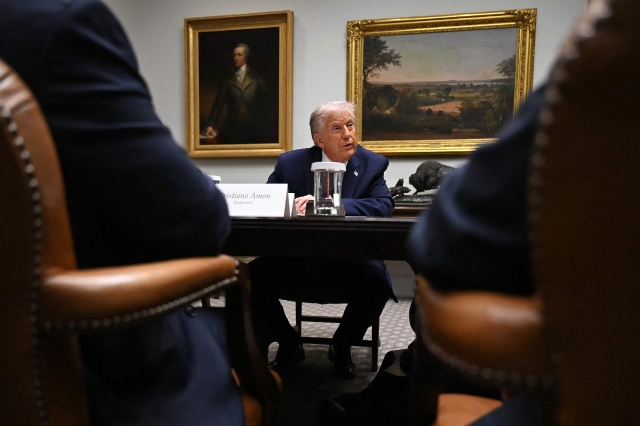
US President Donald Trump speaks during a roundtable discussion in the Roosevelt Room of the White House in Washington, DC, on December 10, 2025. (Photo: CFP)
A politics of disavowal toward the preceding administration
The strategy begins with a blunt assault. It opens by launching a harsh critique of the previous administration, asserting that over the past four years, the United States and the world were brought "to the brink of disaster" and plagued by weakness, extremism, and deadly failures.
The strategy's jarring preamble—a comprehensive indictment of the preceding administration—sets a tone of radical discontinuity. Professor Jin interprets this not merely as political theater but as a symptom of a deeper American ailment rooted in three converging factors: intense political polarization, a uniquely combative leadership style, and the perceived need to establish a clean break for new policies.
"It reflects the worsening polarization of U.S. politics," he notes. "There's a lack of restraint now that wasn't there before." This combative opening, Jin suggests, is amplified by former President Trump's personal approach to governance. "He has a characteristic of relentless struggle—finding endless pleasure in confronting others," Jin observes, noting this style breaks with traditional political decorum.
 Snow lies in front of the White House after the first snowfall of the winter season on December 5, 2025, Washington, USA. (Photo: CFP)
Beyond personality, Jin identifies a strategic "political necessity." For the administration's base, discrediting the past is essential to legitimize a dramatic shift in course. "From the MAGA perspective, there is a logic to these criticisms," Jin explains. He cites perceived strategic overreach, domestic cultural divisions, and economic policies seen as hollowing out the American middle class as key grievances that the document channels. This foundational disavowal, therefore, serves to clear the ideological ground, framing the last administration not merely as flawed, but as fundamentally misguided, thereby justifying the wholesale "America First" recalibration that follows.
A shift in burden, a turn toward home
The new strategy presents a clear transactional demand to Asia-Pacific allies, including Japan and South Korea: significantly increase defense spending to 5% of GDP. Professor Jin frames this as a core mechanism of the revised American compact. "The U.S. feels its allies have freeloaded for decades," he states. The objective is a definitive trans-Pacific burden shift, with partners financing and manning the front-line defenses, potentially allowing Washington to assume a more cost-effective, secondary posture.
This recalibration of external commitments is fundamentally linked to a dramatic strategic re-focusing inward. The true heart of the new doctrine, Professor Jin contends, lies in America's backyard. The document's resolute prioritization of the Western Hemisphere—explicitly invoking a modernized "Monroe Doctrine"—signals that the most urgent threats are now perceived as emanating from within the hemisphere. This pivot is underpinned by potent domestic realities: a Latino population exceeding 68 million and accounting for one in five Americans, juxtaposed with an estimated 11 million undocumented immigrants, predominantly from Latin America. These demographics fuel a powerful narrative of border crisis and cultural transformation.

US Marines with the 1st Combat Engineer Battalion, 1st Marine Division, deploy concertina wire along the southern border wall along the US-Mexico border in San Ysidro, California (Photo: CFP)
"From this administration's perspective," Jin explains, "the threats from mass immigration, drug cartels, and regional instability might be more immediate and visceral than great-power rivalry." Thus, the strategy embodies a dual movement: pushing defense costs onto allies abroad to enable a retrenchment of resources, while simultaneously pulling strategic focus and effort back toward reinforcing hemispheric control and domestic boundaries.
The revived Monroe Doctrine, in this light, is not just foreign policy but a project of demographic and cultural boundary enforcement, funded in part by the expected savings from a redesigned alliance system. The underlying logic is clear: reduced investment abroad enables intensified investment at home, with the Western Hemisphere redefined as the paramount sphere for asserting American power and preserving a perceived national identity.
Dual-track policy to managing the "peer competitor"
Perhaps the most scrutinized shift is the lexical demotion of China from an existential "pacing challenge" to a "near-peer competitor." Professor Jin sees this as a tactical recognition of reality, not a strategic embrace. "This shows a higher and more accurate recognition of China's comprehensive national power," he observes.
He elaborates that this adjusted posture acknowledges a more complex dynamic. "Since China is now seen as a peer, the old approach of unilateral pressure from a position of superiority becomes less effective," Jin explains. The U.S. strategy, therefore, adopts a more differentiated and calculated method. The result is a dual-track policy: an open door for selective economic engagement—driven by a desire to grow the U.S. economy—alongside a determined campaign to wall off technological advantages and maintain a military posture of stark deterrence.

A customer shops at a big box retailer for toys made in China on May 12, 2025, in Chicago, Illinois. (Photo: CFP)
"The approach is to separate issues," Jin states. "Economically, there is a desire for cooperation... but on security, there is no change. The goal is to deter China from changing the status quo." The overall strategy, in his view, seeks a managed and compartmentalized rivalry, combining layers of competition with selective engagement.
A nod to the "Global South"
In a revealing admission, the strategy acknowledges that the U.S. and its allies lack a coherent, joint plan for engaging the "Global South." For Professor Jin, this is a telling, albeit delayed, recognition of what he sees as the defining geopolitical shift of our era. "The biggest 'change' in today's world is precisely the rise of the Global South," he states, emphasizing that this is not a marginal trend but a central transformation.
He elaborates on this point by citing the observations of scholars like Singapore's Kishore Mahbubani. "There is the concept of the 'CIA' era—not the intelligence agency, but C for China, I for India, and A for ASEAN," Jin explains, highlighting the dynamism of Asia's emerging centers of power. This rise, he notes, extends beyond Asia to include other major emerging economies within the BRICS framework and beyond, collectively reshaping the global landscape.
However, Professor Jin points out a stark contradiction in the strategy. While it verbally acknowledges this powerful trend and even notes the vast resources available to the U.S. and its allies to engage with it, the document offers no substantive vision or proactive plan. "The statement acknowledges a pluralizing world order," he observes, "even as the broader strategy seeks to retrench from it."

Cargo containers are stacked aboard a ship at the Jakarta International Container Terminal in Tanjung Priok Port, Jakarta (Photo: CFP)
As Jin concludes, the U.S. appears to be recognizing the reality of a multipolar order while simultaneously choosing to focus its finite resources and attention on solidifying hemispheric dominance and managing peer competition with China. The nod to the Global South, therefore, seems less like a blueprint for new partnership and more like a tactical admission of a strategic blind spot—an acknowledgment of a world it no longer seeks to lead in a comprehensive way, but cannot afford to ignore completely.
Author: Guo Zedong
Editor: Yuan Zixiang, James Campion, Shen He