











Huang Haoyong, a Singapore-born engineering academician with ancestral roots in Guangdong's Jieyang, joined Beijing Normal University at Zhuhai (BNUZ) on a full-time basis in 2022. He devotes himself to cutting-edge research such as seawater desalination and water treatment, helping to improve water supply security for the offshore islands in the Guangdong-Hong Kong-Macao Greater Bay Area.
Huang earned his Master's and PhD degrees in Engineering in Singapore and the United States. He then became an environmental engineering expert specializing in theoretical research and technology transfer in wastewater treatment and reuse. With seawater desalination technology widely applied in Singapore, his scientific research reached successive milestones. While teaching at the National University of Singapore (NUS), he was elected as an Academician of the Singapore Academy of Engineering, becoming a leading scientist in the field of "unconventional water treatment" worldwide.
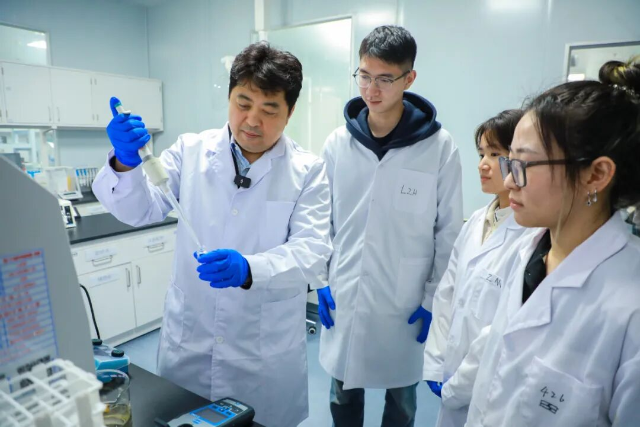
At the age of 50 and already serving as the Dean of the NUS Environmental Research Institute, Huang decided to "make a change." In August 2022, through Zhuhai's high-level talent recruitment program, he joined BNUZ, serving as the academic leader of the Center for Water Science Research at the Advanced Institute of Natural Sciences.
Huang's research came at an opportune time for Zhuhai's needs. After the annual typhoon season, seawater often flows back into the Xijiang River, Zhuhai's primary water source, leading to increased salinity in tap water. There is room for improvement in water quality, and solutions include seawater desalination. Although desalination technology is mature globally, reducing energy consumption costs remains a key bottleneck in Zhuhai—precisely the expertise of Huang's team.
His team's core technology focuses on optimizing efficiency and reducing energy consumption. For example, he explains that optimizing pretreatment and reverse osmosis membrane technology and operations can delay membrane fouling, thereby extending cleaning cycles and service life.

Furthermore, the AI system developed by his team can monitor parameters in real-time and automatically adjust them during wastewater treatment, precisely controlling chemical dosing and energy consumption to achieve energy savings and increased efficiency. Huang stated that Zhuhai is planning seawater desalination projects, and he is delighted to help reduce future water costs for the islands.
Author: Liu Zixin
Photo: Guangzhou Daily