











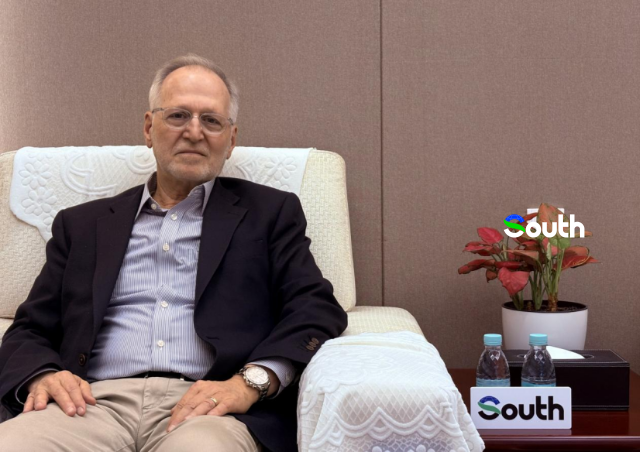
Robert Koopman receives an exclusive interview with South in Shenzhen on Dec. 8, 2025. (South Photo)
"I would describe the global economic context (in 2025) as complex," underscored Robert Koopman, Former Chief Economist at the World Trade Organization (WTO).He also projected two risks for the world economy next year: demographic issues in major economic growth hubs and uncertainty stemming from US President Donald Trump's tariff policies.
This assessment and speculation arose during a recent exclusive interview with South after the 2025 Workshop on "Trade, Regulation, and Academic Insights for the Next Generation" kicked off in Shenzhen, focusing on global trade and economic policies.

A semi-truck carries a cargo shipping container across the Vincent Thomas Bridge as containers sit stacked underneath Evergreen cranes at a container terminal at the Port of Los Angeles in California on Feb. 3, 2025. (CFP Photo)
A complex global economy in 2025
Koopman provided a comprehensive overview of regions worldwide in 2025 and highlighted critical industries for economic growth during the interview.
Regarding the United States, he noted that the country has been experiencing significant growth, largely attributed to its AI tech sectors, which have attracted substantial equity investment.
Europe has struggled with mediocre growth this year, as Koopman outlined. "We see Europe discussing the need to create a more innovative and integrated economy, standing more on its own in terms of servicing its domestic market and its role in the global economy," he added.
For China, Koopman observed that it is attempting to rebalance its economy, transitioning from its historical growth pattern toward a more service-led and consumption-led model.
"China's exports have grown, but its imports have declined in the first half of 2025. This changes its historical position, where for the past 20 years or so, it was a rapidly growing exporter and also a very fast-growing importer," Koopman noted.
Imports have been slowing while exports continue to grow. Despite Trump's tariffs, China's customs agency announced on December 8 that the country's accumulated trade surplus reached $1.08 trillion through November, exceeding $1 trillion for the first time.
Koopman views this as a natural step for China's outward foreign direct investment, with many Chinese firms investing in nearby countries and diversifying their production bases.
"When countries grow and develop, their labor costs rise, and the composition of their domestic economy starts shifting more toward services. You tend to see them outsource manufacturing to lower-cost labor environments," he added.
Given the current status of these major economic growth centers—the US, Europe, and China—Koopman illustrated what this means for other developing countries in South Asia, Africa, and Latin America amid uncertainties surrounding global value chains and trade policy emerging from the US.
"It's a very interesting and complex situation where the growth patterns we've observed for the last 25 to 40 years now seem to be changing," he pointed out.
"There's a lot of uncertainty regarding what that means for future economic integration and opportunities for developing countries to tap into global demand."
However, the economic growth spurred by critical industries provides a silver lining, as Koopman emphasized.
"We see growth in advanced technology sectors such as AI and semiconductors. Those sectors could potentially have significant productivity effects," he added.

Donald Trump holds a signed executive order after delivering remarks on reciprocal tariffs during an event entitled "Make America Wealthy Again" at the White House in Washington, DC, on April 2, 2025. (CFP Photo)
Looming risks ahead in 2026
Looking ahead to 2026, Koopman identified two concerns for the world economy next year: the role of population growth in the US, China, and the EU as primary economic growth hubs, and the uncertainty brought by Trump's tariff policies.
"One of the bigger challenges we're facing right now is the role of population growth. We see major demographic challenges in the global economic hubs: China, Europe, and the US," he warned.
Koopman told the South reporter that when considering long-term economic growth, the number of workers really matters. Their quality and their ability to interact with existing capital are also important.
"If one country's population shrinks, that usually is not good for economic growth in the near term, and it also has longer-term implications as it loses some of its innovations," he noted.
Additionally, he highlighted that immigration is potentially a significant source of innovation. It also increases the labor force and demand.
"If the US no longer encourages immigration and also deports a large number of immigrants, that's going to have significant demographic effects on the potential for US economic growth," he added.
The former WTO chief economist is quite concerned about the demographic trend, suggesting that the number of workers and consumers in the global economy is likely to shrink. This has implications for firms' investment and innovation, which could become a very significant factor in long-term global economic growth.
As for tariffs, Trump appears comfortable with them now, as Koopman observes. Even if the Supreme Court fights against Trump, he is likely to implement other mechanisms to maintain the tariffs at their current levels.
Nonetheless, Koopman detailed two major forces that could affect this trajectory.
If the cost of living in the US continues to rise, that might provide an incentive for Trump to reduce tariffs, albeit in a targeted way. Trump recently decreased tariffs on certain imported agricultural goods that increase food costs.
The other factor is if countries take actions that Trump disapproves of, he is likely to increase tariffs on them. He uses his political power to achieve other objectives he is interested in pursuing.
"We have elections coming up in 2026. If there's a significant Democratic wave, the United States Congress is likely to become more aggressive in pushing back against some of Trump's policies," Koopman added.
Reporter | Zhang Ruijun
Photo | Zhang Ruijun
Editor | Yuan Zixiang, James Campion, Shen He