







Guangdong recorded over 300,000 migratory birds across the province during the 2025 autumn–winter season, setting new records for some rare species, monitoring data shows.

Black-faced Spoonbills
Western Guangdong has reported several significant new bird records. Five Relict Gulls—a species under national first-class protection—were observed for the first time in the wetlands of the Leizhou Peninsula in Zhanjiang, confirming the area's role as an international migratory stopover. At the same time, the Masked Booby, a species under national second-class protection, was recorded for the first time in Guangdong's offshore waters, expanding its known coastal range in China.
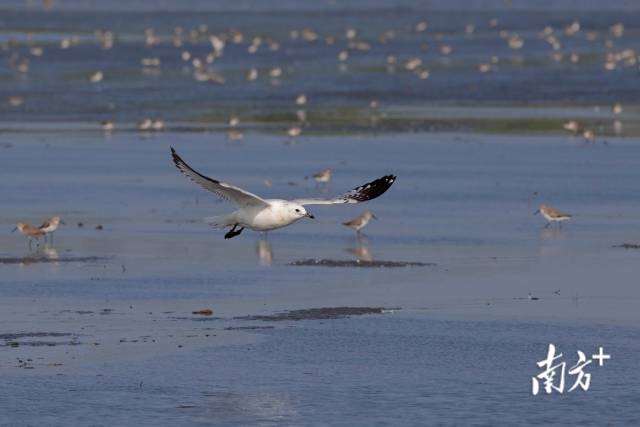
Relict Gull (Photo: Cheng Li and Zhuang Lifeng)
In the Pearl River Delta, wetlands remain key wintering grounds. Nansha Wetland in Guangzhou, with 198.18 hectares of mangroves, attracts over 100,000 birds each winter and recorded its first national first-class protected Glossy Ibis last year, bringing the total number of such species there to five. Elsewhere, new records were reported in Shenzhen Bay and Dongguan's Binhai Bay, where the Northern House Martin and Saunders's Gull were added. Dongguan has now documented 363 wild bird species, including 10 nationally first-class protected species, reflecting its ecological transformation from a manufacturing hub.

Masked Booby (Photo: Xiong Chunhui)
Eastern Guangdong has also achieved historic milestones. Meizhou recorded its first-ever sighting of the endangered Oriental Stork, while the Haifeng wetlands in Shanwei documented a record 451 Black-faced Spoonbills in 2025—more than 16 times the number observed in 2004. In Shantou, the Hanjiangkou wetland has repeatedly recorded the Chinese Crested Tern, confirming its importance as a key habitat in South China.

Glossy Ibis (Photo: Ou Gan)
Ongoing wetland restoration and ecological corridor development are steadily improving migratory routes and habitats across Guangdong province, reinforcing its role along the East Asian–Australasian Flyway.
Author | He Fengyu
Photo | Nanfang Plus
Editor | Wei Shen, James Campion, Shen He