











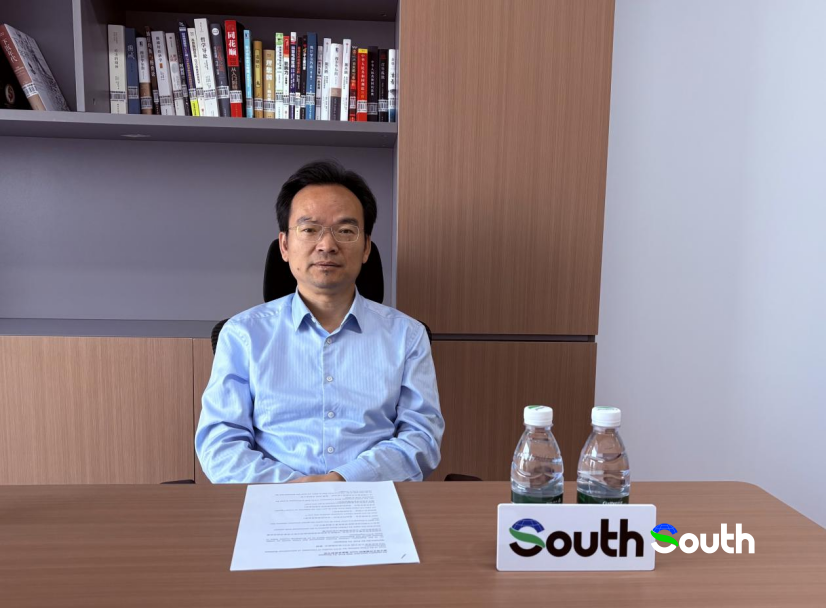
Tu Xinquan receives an exclusive interview with South in Shenzhen on Dec. 8, 2025.
"The global governance system is comprised of a trinity of security, trade, and currency. These three pillars are indispensable and interconnected," noted Tu Xinquan, Dean of the China Institute for WTO Studies at the University of International Business and Economics.
He made this claim during a recent exclusive interview with South after the 2025 Workshop on "Trade, Regulation, and Academic Insights for the Next Generation" kicked off in Shenzhen, focusing on global trade and economic policies.
Given the currently dysfunctional global governance system, Tu expressed that countries worldwide need a grand deal implying top-down, fundamental reforms and major adjustments to the system.

Tu Xinquan delivers a lecture on subsidies in Shenzhen on Dec. 8, 2025.
Security as the foundation
"Security is the most crucial and fundamental," he highlighted. Without mutual trust and a shared understanding of security among countries, there will be no cooperation.
The General Agreement on Tariffs and Trade (GATT) and the World Trade Organization (WTO) could be established because each country viewed the others not as enemies, and there was no hostility. Founded in 1947, GATT was born shortly after World War II, and the WTO was established in 1995, following the end of the Cold War.
According to Tu, the main current security issue is the relationship between China and the United States. The two are still in the process of competition and have not yet reached an equilibrium. When and in what form this equilibrium will be reached remains uncertain.
"Our approach is primarily crisis management. We must avoid conflict between China and the US. Neither side wants a conflict, especially a military conflict," Tu noted.
A consensus and framework for security have not yet been formed. A balanced and stable framework cannot be established at present, which takes time.
"This is the biggest problem," he warned. "Without this, a long-term balanced global economic system is impossible."

Shipping containers are stacked at the Port of Los Angeles in California on Oct. 15, 2025. (CFP Photo)
Two issues behind trading and monetary system
Regarding trade and the monetary system, Tu analyzed that these two issues must be considered together as they are two sides of the same coin.
As for trade, China has a trade surplus, while in terms of currency, the US has a surplus. The US financial account has a large surplus, while its current account has a deficit. China faces just the opposite situations regarding the two accounts.
"Two core issues stand out—the US dollar and China's manufacturing sector," Tu outlined.
China's manufacturing sector is extremely robust. According to World Bank data, its manufacturing sector, worth US$4.7 trillion, was 60% larger than the US's, worth US$2.9 trillion in 2024.
Meanwhile, the US has a dominant dollar in the international reserve system. International Monetary Fund data revealed that the US dollar's share of allocated foreign exchange reserves in the first half of 2025 roughly lingers at 57%, while the Chinese renminbi remains at 2.12%.
"This is also an imbalance," Tu pointed out. Ideally, both should be more balanced. He proposed that the dollar should relinquish some of its status to allow the RMB to benefit. China can also reduce its surplus with the US and share more of the Chinese market.
"This is how a relative equilibrium is formed. Equilibrium cannot be achieved by solving only one problem. Simply addressing trade issues cannot reach equilibrium," he added.
"The core reason for the large US trade deficit is a too powerful US dollar," Tu noted bluntly.

An employee moves on the floor at the Hyundai Motor Group Metaplant America in Ellabell, Georgia on Mar. 26, 2025. (CFP Photo)
The US cannot redirect resources to manufacturing due to the dollar's dominant monetary status. He illustrated that given the dollar's monetary status, it's easier for US firms to earn money elsewhere.
"Why do they engage in manufacturing? Businesses lack the intrinsic motivation," he added.
US manufacturing capital holding dollars can invest worldwide. Since domestic costs are high, why not invest in a lower-cost region and then export back to the US? This is the fundamental reason for US deindustrialization and outsourcing, as Tu underlined.
Naturally, the US government forces firms to participate through tariffs and subsidies. "But can you change their mindset with just these policies? You must adjust the dollar. Otherwise, it's impossible," he noted.
Also, Tu attributed the dollar's slight depreciation this year partly to Donald Trump. However, excessive dollar depreciation will boomerang on the US as its financial accounts hinge heavily on the dollar's purchasing power.
"Therefore, a new equilibrium must be reached," Tu observed. To achieve relative balance in the current account, he suggested that the US needs to partially relinquish its dominant currency status. It's a process requiring China's collaboration and policy adjustments from the US.
A crucial way for the US to balance its current account, according to Tu, is to attract foreign investment. "Why not have other countries transfer production capacity to the US?" he inquired. At least some high-tech production capacity could be restored.
Trump has even pressured other countries to invest in the US, such as countries in the Middle East, the EU, Japan, and South Korea, but has refused Chinese investment.
"China is fully capable of investing. The issue then returns to security. If there are no security concerns, there is no harm in Chinese investment in the US," Tu stated.
"If you truly want a fundamental adjustment, the entire system must be changed. Otherwise, the current dysfunctional system can only be maintained," he added.
Reporter|Zhang Ruijun
Photo | Zhang Ruijun
Editor | Yuan Zixiang, James Campion, Shen He