











A new species of frog has been identified in Guangdong by a research team from Sun Yat-sen University. Named Amolops guangzhouensis, or the Guangzhou torrent frog, the species was described in a study published in the international zoological journal Zootaxa in January 2026.
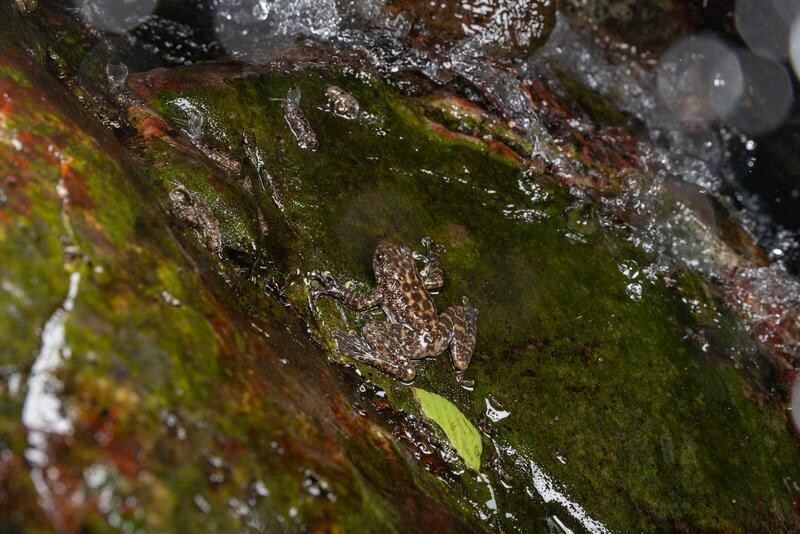
The frog was found at several locations, including Conghua District in Guangzhou and the adjacent Longmen County in Huizhou City. One of the specimens was collected from the Nankunshan Provincial Nature Reserve in Huizhou, which has now recorded four amphibian species from its area. The research involved scientists from the Chengdu Institute of Biology, Chinese Academy of Sciences, Guangzhou Senmao Ecological Research Co., Ltd., South China Agricultural University, and the reserve's management bureau.

The holotype of Amolops guangzhouensis sp. nov. (SYS a009405, male) in life: (A) dorsolateral view; (B) opisthenar surface of left hand, showing the features of the nuptial pad and nuptial spines; (C) dorsal view; (D) ventral view; (E) ventral surface of right hand; (F) ventral surface of left foot. (Photos by Shuo Qi)

Paratypes of Amolops guangzhouensis sp. nov. in life: (A) SYS a009051, female; (B) SYS a009402, female; (C) SYS a009403, female; (D) CIB 119033, male; (E) SYS a009451, female; and (F) mature oocytes expelled from the paratype SYS a009403 after capture. (Photos by Shuo Qi, Han-Ming Song and Fu-Xuan Wang)
The Guangzhou torrent frog is a medium-sized frog with no significant difference in body size between the sexes. Adult males have a body length of 43.2–44.2 mm, while adult females measure 41.3–46.6 mm. It has an olive-colored back with yellow and dark brown patches, a white underside, and tiny translucent white spines across its skin. During the breeding season, adult males develop distinct yellow nuptial pads on their first fingers.
Genetically, the new species belongs to the Amolops dalyunensis group, a cluster of torrent frog species within the genus Amolops. According to the study, it represents an independent evolutionary lineage and is the westernmost known member of its species group, expanding the recognized geographic range of the group. The genus Amolops, commonly called torrent frogs, is one of the largest groups within the true frog family Ranidae, with 89 recognized species found across Asia.
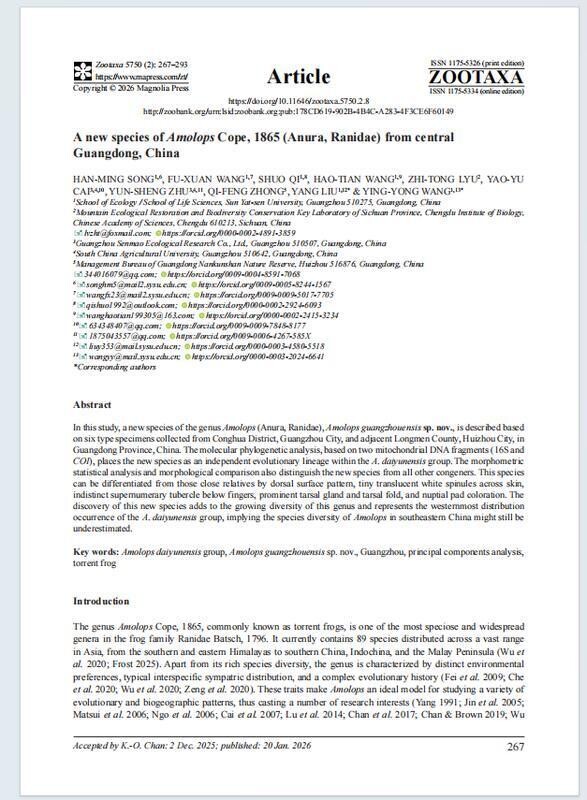
Zhong Qifeng, head of the conservation management department at the Nankunshan Nature Reserve, noted that amphibians, with their limited mobility and often subtle physical differences, can harbor significant hidden diversity. The frequent discovery of new and endemic species in the Nankunshan area highlights its ecological uniqueness as a potential natural laboratory for studying speciation. The reserve is already recognized as the type locality for three other amphibian species: the Nankunshan music frog (Nidirana nankunensis), the Nankunshan horned toad (Boulenophrys nankunensis), and the Guangdong stream toad (Torrentophryne gargarizans).
Author | Feng Huiting
Photo | Nanfang Plus, Zootaxa
Editor | Liu Lingzhi, James Campion, Shen He