







"China has become a very good role model for Indonesia," Professor Heri Hermansyah, Rector of Universitas Indonesia, said in a recent interview with South during a symposium hosted by South China Normal University. His comments come as the two nations celebrate 75 years of diplomatic relations—a partnership growing not only in depth but also in strategic scope.
The economic foundation is substantial. China remains Indonesia's largest trading partner, with bilateral trade hitting $147.8 billion in 2024, a 6.1% increase year-on-year. It is also Indonesia's second-largest source of foreign direct investment, with joint projects now spanning infrastructure, green technology, and the digital economy. Within this robust framework, Hermansyah stressed that cooperation must evolve beyond trade and investment into the realms of education and innovation.
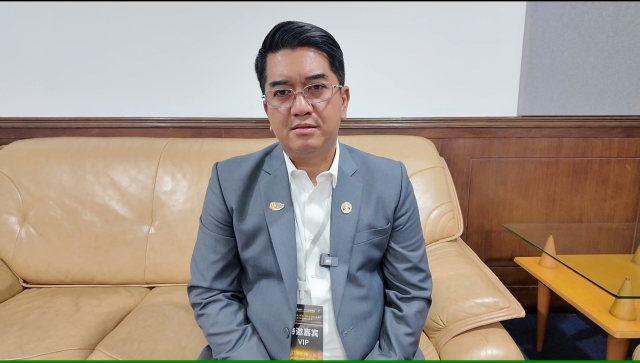
Professor Heri Hermansyah, Rector of Universitas Indonesia, speaks with South during an interview (Photo: Guo Zedong)
He specifically highlighted Indonesia's Golden Indonesia 2045 vision—a national roadmap to transform the country into one of the world's top five economies by its independence centenary. This ambition is closely linked to another historic undertaking: the ongoing relocation of Indonesia's capital from Jakarta to the new smart city of Nusantara in East Kalimantan. Designed as a green and sustainable administrative center, the move represents a tangible step toward the 2045 goals of equitable and innovation-led development.

A construction site in the new capital city of Nusantara, a city still under construction on the island of Borneo on Aug. 17, 2024. (Photo: CFP)
"To realize these ambitions, universities must lead through education, research, and innovation," Hermansyah stated. "China's developmental experience—especially in building modern cities and fostering tech ecosystems—offers us valuable lessons." The capital project, he noted, opens further avenues for China-Indonesia collaboration in sustainable urban development, digital governance, and green infrastructure.
Having attended the World University Presidents Forum in Hangzhou earlier in 2025, Hermansyah praised Chinese institutions like Zhejiang University for effectively translating academic research into startup culture and technological advances. "We can learn greatly from China's model of integrating universities with industry," he observed, which he sees as critical for supporting both the new capital and national industrial transformation.
Trained as a chemical engineer, Hermansyah also emphasized Indonesia's urgent need to climb the value chain. "We are rich in natural resources, including nickel, palm oil, and coal, but we must develop domestic processing capabilities," he explained. "Technology transfer and cooperation with China can significantly accelerate this shift," enabling Indonesia to evolve from a raw material exporter to an industrial and innovation-led economy.
People-to-people exchanges, he noted, are already strengthening ties. Hermansyah cited hundreds of student and faculty exchanges between Indonesian and Chinese universities and called for expanded dual-degree programs. "Imagine a generation that studies two years in Indonesia and two in China," he said. "They would graduate not only with dual qualifications but also as genuine cultural and professional bridges," equipped to contribute to projects like Nusantara and broader bilateral initiatives.
Looking ahead, Hermansyah expressed optimism, framing education not as a standalone sector but as the essential foundation for sustainable bilateral progress. "Education is the key," he concluded, "to developing the human capital, research, and innovation that will benefit both Indonesia and China for decades to come." With the Golden Indonesia 2045 vision and the historic capital relocation guiding national strategy, the partnership between the two countries is poised to enter a more integrated and forward-looking phase.
Reporter: Guo Zedong
Editor: Yuan Zixiang, James Campion, Shen He