











Shenzhen's Nanshan District has become China's first district-level economy to surpass a gross domestic product (GDP) of 1 trillion yuan (US$140 billion) in 2025, according to the district government work report released during the local people's congress session today.
District Mayor Li Xiaoning noted that over the past five years, Nanshan achieved an average annual GDP growth rate exceeding 5.8%, rising from 652.7 billion yuan in 2020 to cross the trillion-yuan mark.

People visit the global service center in the Nanshan District. Photos by Xinhua
As a major manufacturing and sci-tech innovation hub in the Guangdong-Hong Kong-Macao Greater Bay Area, Nanshan's economic output now exceeds that of some European countries.
This milestone rests on a solid foundation of high-tech industries. Statistics show that emerging strategic industries contributed 60% of Nanshan's GDP.
A narrow stretch between the southern slopes of Yangtai Mountain and Tanglang Mountain is locally known as "Robotics Valley," home to more than 20 robotics firms and over 200 companies in their supply chains. Additionally, more than 1,000 artificial intelligence companies in the district have each reached the threshold of 20 million yuan in annual revenue from their main business operations.
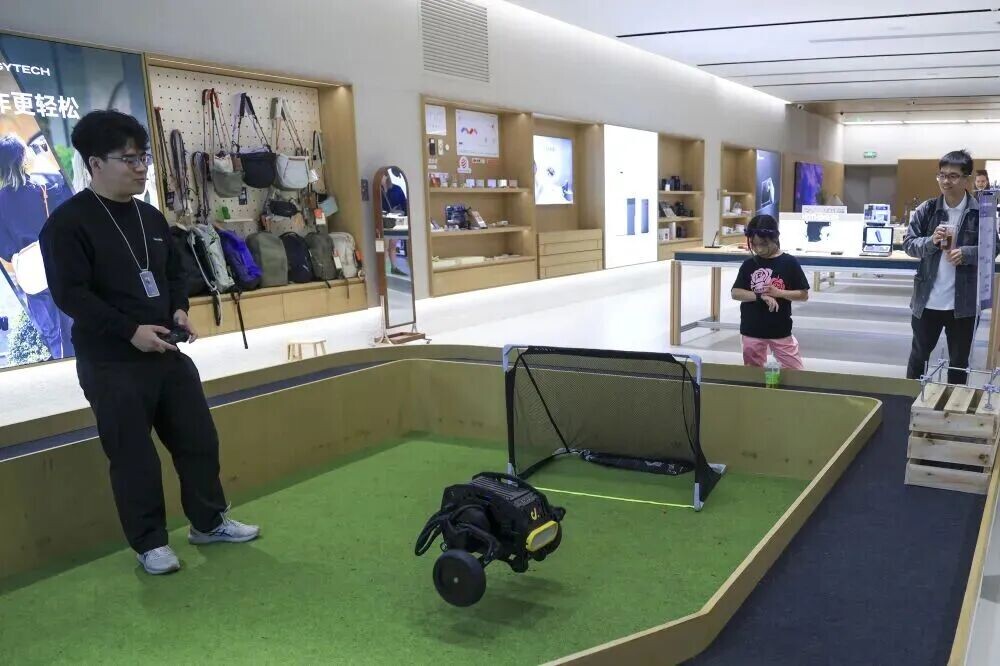
Clients explore robotic products at an INNO100 flagship store in Nanshan.
Nanshan hosts over 200 publicly listed companies — a figure comparable to that of some Chinese provinces. Zhang Jingping, director of the district's science and technology innovation bureau, stated that Nanshan has been continuously optimizing its business environment to support innovation among its roughly 600,000 registered enterprises. "We aim to cultivate a rainforest-like ecosystem where a few giants rise tall, a large number of SMEs thrive, and even more startups explore new frontiers," Zhang said.
With industry leaders such as Tencent and DJI headquartered in the district, Nanshan is home to six software firms and seven internet companies ranked among China's top 100.
Statistics indicate that the district's software and internet industry revenue exceeded 900 billion yuan in 2025.
Guo Wanda, vice president of the China Development Institute (Shenzhen), observed that Nanshan exemplifies how the vast potential of sci-tech innovation can drive economic growth beyond the constraints of land and resources.
Although occupying only one-tenth of Shenzhen's total area, Nanshan was the birthplace of the pioneering "Shekou Model" and iconic reform-era slogans such as "Time is money, efficiency is life."