











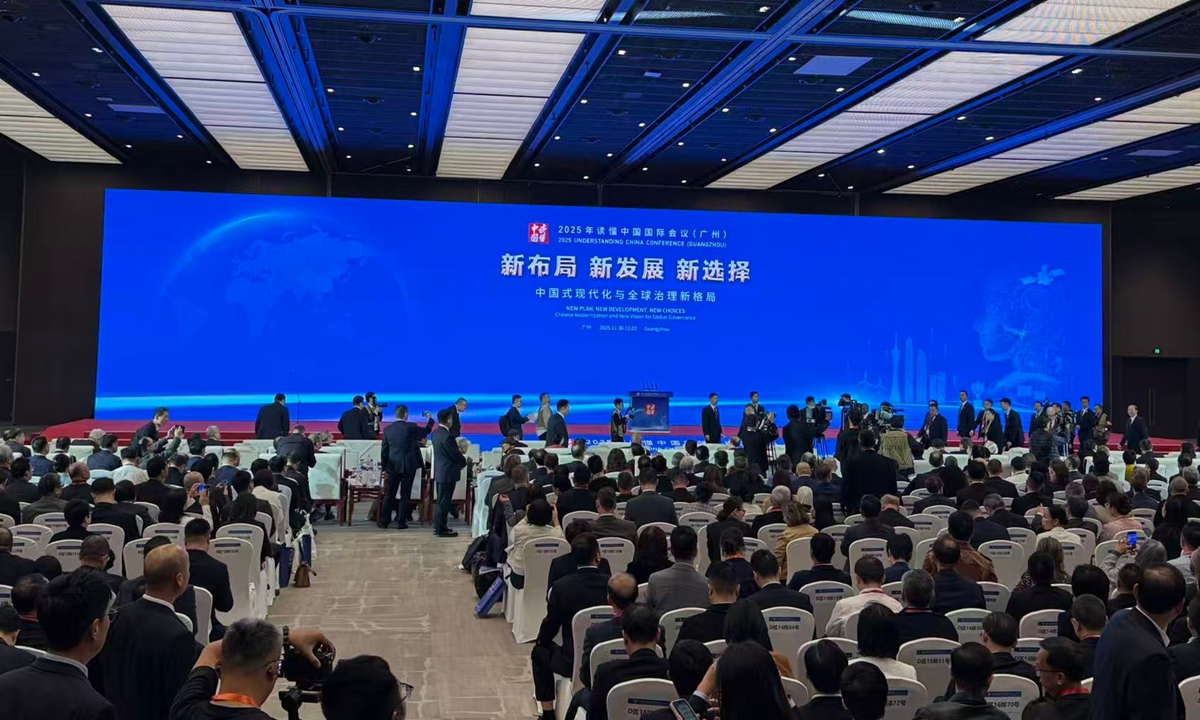
 The venue of the opening ceremony of 2025 Understanding China Conference (Guangzhou) on Monday. Photo: Li Aixin/GT
The 2025 Understanding China Conference, drawing around 800 participants from both China and abroad under the theme "New Plan, New Development, New Choices - Chinese Modernization and New Vision for Global Governance," officially opened on Monday in Guangzhou, South China's Guangdong Province.
"This year's conference put forward two new tasks for 'understanding China.' One is to understand the 'Recommendations of the Central Committee of the Communist Party of China for Formulating the 15th Five-Year Plan for National Economic and Social Development.' The other is to understand the China-proposed four global initiatives, including the Global Governance Initiative," Zheng Bijian, founding chairman of the China Institute for Innovation and Development Strategy (CIIDS), who is also known for coining the term China's "peaceful rise," said in his speech on Monday.
When it comes to understanding the 15th Five-Year Plan, Zheng said it is about China's 1.4 billion people continuing running our own affairs well, while more consciously planning national development within the global landscape and securing strategic initiative amid fierce international competition. He also stressed that development is the key to solving all of China's problems.
Many participants believe that high-quality development is one of the core ideas of China's 15th Five-Year Plan. During his speech at the conference, Andrey Bystritskiy, Chairman of the Board of the Foundation for Development and Support of the Valdai Discussion Club, shared his impressions of China, noting that visitors can personally experience the remarkable appeal of its modern infrastructure, which includes an extensive and luxurious high-speed rail network that connects the entire country, the breathtaking scale of digital technology applications, a highly efficient and well-integrated transportation system, and a sophisticated production ecosystem delivering cutting-edge products with extraordinary efficiency.
Li Cheng, professor of political science and founding director of the Centre on Contemporary China and the World at the University of Hong Kong, noted that China is rapidly emerging as a global hotbed for scientific and technological innovation. He pointed out that a large number of technology-driven cities have risen across the country. Beyond the traditional powerhouses of Beijing, Shanghai, Shenzhen, and Guangzhou, cities such as Hangzhou, Suzhou, and Nanjing are also extremely dynamic.
Li added that education and talent are playing a foundational and strategic supporting role. "Today, one-quarter of the world's engineers live in China - eight times the number in the US."
In an interview with the Global Times, German Investor Peter Jungen, Chairman of Peter Jungen Holding GmbH, shared another detail. "If you look at the patent register pages, China is number one in the world in terms of the number of patents registered. The number is more than twice as many as that of the US."
Another noteworthy part of China's 15th Five-Year Plan is the country's commitment to opening up. As Zheng said in his speech, "In terms of developmental foundation and strengths, China is the only country in the world that possesses all industrial categories listed in the International Standard Industrial Classification of All Economic Activities, and it enjoys the advantage of an enormous domestic market."
Nevertheless, he stressed, "the 15th Five-Year Plan once again makes it clear that China has no intention of pursuing a closed-door, self-centered modernization. On the contrary, we embrace openness and warmly welcome other countries to actively participate in Chinese modernization, viewing China's reform and development as a shared opportunity for the common progress of all countries."
China is the world's second-largest consumption and import market, as well as the only developing country to host a national-level import-themed expo. In November, China shortened its negative list for foreign investment to 29 items, eliminated all manufacturing restrictions, and opened services such as value-added telecoms and healthcare.
"China cares about prosperity for all, this is what I gather from the different speeches by Chinese leaders and scholars," Zafar Uddin Mahmood, former special envoy for the China-Pakistan Economic Corridor, told the Global Times on Monday.
He added that China is a more inclusive country because the Chinese people talk about prosperity for all, not only for the Chinese people themselves. "You cannot find any other government leadership so concerned about not only its own people, and at the same time, people in the world."
Mahmood gave three examples to the Global Times. First, more than 140 countries and regions in the world have benefited from China's Belt and Road Initiative in one way or another; second, as the world's second-largest economy, "there can hardly be a person in the world who is not using a Chinese product in one way or another - be it phones, clothes, glasses… every person in this world, rich or poor, has access to affordable Chinese products"; third, "now we have four global initiatives, they reflect China's desire and commitment to the well-being of all global humanity."
When sharing his views on why it is important to understand both the 15th Five-Year Plan, which takes care of China's own development, and China's global initiatives, which is about joining hands with other countries to promote the world's development, Rafael Zerbetto, a Brazilian expert at China International Publishing Group and a recipient of the Chinese Government Friendship Award, told the Global Times that China's stability and development are closely intertwined with the rest of the world, and vice versa. "So this is China's way - focus inward for development, reach outward for common prosperity."
"The real challenge for 'understanding China' is not lack of information or lack of understanding. What China is doing, what China's objectives are, how China looks at the world, they are known to everybody," Mahmood told the Global Times. "The challenge is some people in the West don't want to understand, they have an emotional difficulty in accepting the rise of China," he said.
"But China will keep doing what it is doing," Mahmood continued, "and one can be confident that more and more people, even in the Western world, will come to recognize China. Let the facts speak for themselves."
Among the participants, approximately 200 are delegates from 72 countries and regions, as well as representatives from Hong Kong and Macao special administrative regions. Seventy percent come from Global South countries, and 70 percent are attending the conference for the first time. A series of related thematic forums had already begun on Sunday.