











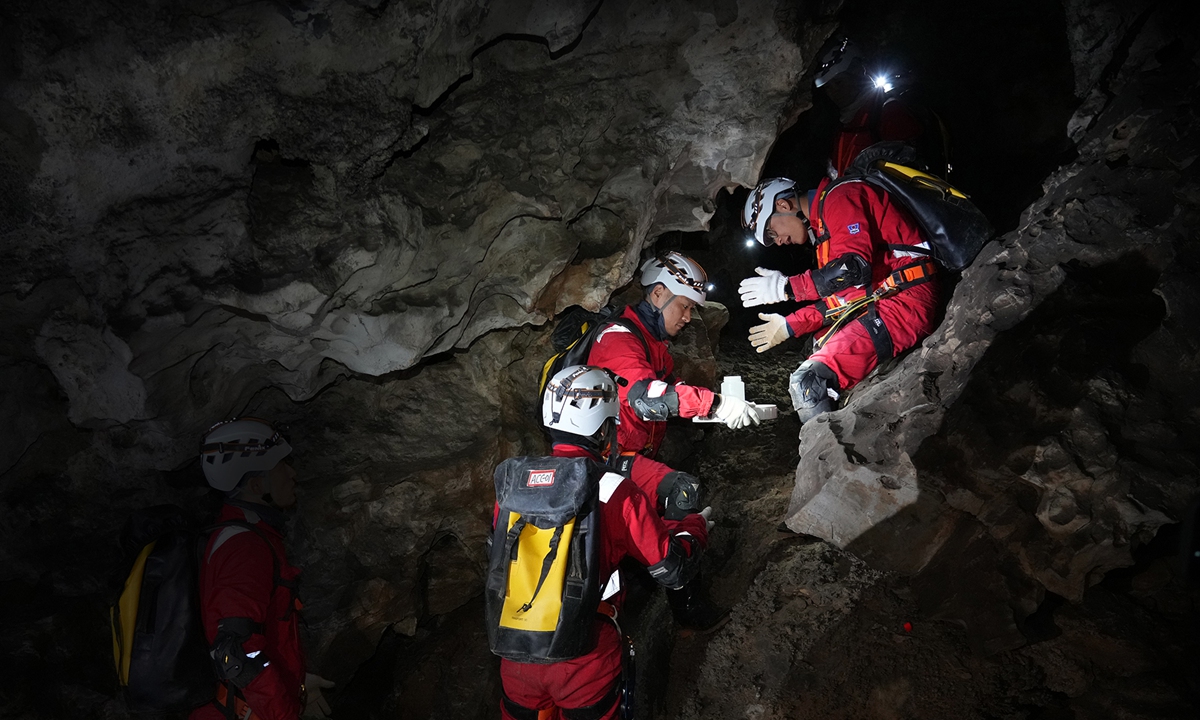
Taikonauts participate in China's first cave training in Wulong district, in Southwest China's Chongqing Municipality in December. (Photo: courtesy of Astronaut Center of China)
China's first astronaut cave training, organized and led by the Astronaut Center of China (ACC), successfully concluded in Wulong district, in Southwest China's Chongqing Municipality, Global Times learned from the ACC on Monday. During the training, a total of 28 taikonauts, divided into four groups, completed six days and five nights of cave training, which, according to the ACC, provided strong support for future astronauts to undertake longer-duration space station flights and crewed lunar landing missions.
Through scenario designs closely aligned with actual mission requirements, an intensive training mode, and various technological innovations, the program has innovatively enriched the content of China's astronaut training system, practically honed the astronauts' comprehensive abilities to cope with extreme environments, as the ACC elaborated in a statement regarding the cave training program it provided to the Global Times on Monday.
According to the ACC, the cave environment shares similarities with the extreme conditions in space, such as isolation, confinement, and high risks.
Wu Bin, deputy chief designer of the Astronaut System for China's Manned Space Program, explained that the training requires astronauts to complete designated tasks, including cave exploration, scientific research, material management, and life support.
"During the process, taikonauts must navigate extremely narrow passages, climb and rappel down sheer cliffs, endure prolonged wet and cold conditions, and face tests of extreme physical stamina. They also need to overcome numerous challenges such as fear of darkness and sensory deprivation," Wu said.
"The purpose of this training is to enhance astronauts' abilities in risk response, independent work, team collaboration, emergency decision-making, scientific investigation, physical endurance, and psychological resilience in extreme environments," Wu Bin said. "It also serves as a comprehensive assessment of the taikonauts."
Previously, Taikonaut Ye Guangfu and five other prospective astronauts from Japan, Russia, Spain, and the US spent six nights in Sardinian caves from July 1 to 7, 2016, simulating a mission to another planet, during the European Space Agency (ESA) underground training course CAVES (Cooperative Adventure for Valuing and Exercising human behavior and performance Skills).
Ye served as one of the training commanders in the latest cave training session in China. He stated that China's cave training places greater emphasis on stimulating astronauts' independent capabilities.
By reducing support interventions inside the cave and strengthening psychological monitoring and support, it has accumulated valuable experience for future space flights, he said.
According to Jiang Yuan, an astronaut instructor from the ACC, psychological resilience is a crucial quality for astronauts during space flights. Caves represent a typical scenario of extreme confinement and isolation, with core psychological challenges including sensory deprivation, uncertainty of risks, and restricted social isolation. This training holds significant scientific value for the study and intervention of astronauts' psychological states in extreme environments, Jiang revealed.
According to the ACC, through technical methods such as tracking and evaluating psychological states and providing group psychological support, the training not only helped astronauts successfully adapt to the cave environment but also gathered a large amount of data on human psychological changes in extreme conditions.
These data will provide important support for building psychological support systems for astronauts in future long-duration space station missions and crewed lunar landing missions, the center said.
Zhu Yangzhu, who served as China's first-ever spaceflight engineer during the Shenzhou-16 spaceflight mission in 2023, also participated in the cave training in Chongqing. He said that "the cave training environment is confined and features complex terrain. It simulates both the isolation and unknowns of deep-space exploration while pushing physical and mental limits to the extreme. This experience has given us a deeper understanding of the importance of teamwork and coordination, further honed our emergency response and psychological resilience capabilities, and accumulated valuable experience for future missions."
Global Times also learned from the ACC that the taikonauts also concurrently underwent two days of jungle training per session. Through practical exercises such as the use of survival items and wilderness survival skills, the training enabled the participating astronauts to further master basic knowledge and skills for jungle survival, enhance their ability to survive in harsh wilderness environments, and temper a strong sense of close teamwork and collaboration, the ACC said.