











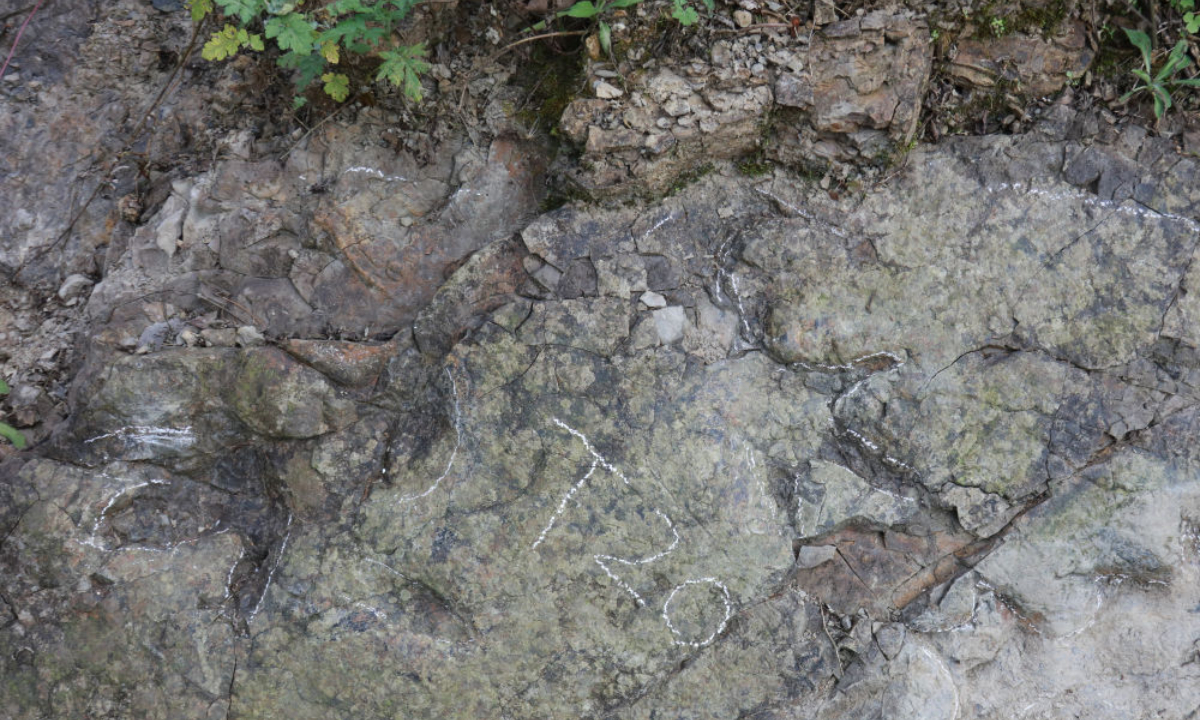
Multiple footprints on a sedimentary rock wall Photo: Xinhua News Agency
More than 20 vertebrate track fossils, including multiple dinosaur footprints estimated to be about 200 million years old, have been identified on a rock wall in Dujiangyan, Southwest China's Sichuan Province, marking the first discovery of dinosaur track fossils in the region, according to a preliminary investigation by a research team led by Xing Lida, a dinosaur expert and an associate professor at the China University of Geosciences (Beijing).
"This is the first discovery of dinosaur footprints in Dujiangyan, providing valuable physical evidence for decoding early dinosaur evolution and reconstructing ancient environments," Xing told the Global Times on Sunday.
The fossil site, on a sedimentary rock wall, was found on November 23 by an outdoor enthusiast. While hiking with his family that day, he noticed the unusual markings on the rock wall. The clear claw impressions and compression textures immediately led him, drawing on his background in geology to suspect they were trace fossils.
After the initial report, Xing's team conducted a further examination and confirmed that the traces originated in Upper Triassic strata, dating back roughly 200 million years.
According to Xing, the team recorded more than 20 footprints of varying sizes distributed across the rock surface. The tracks fall into three main categories: medium and large theropod footprints, small theropod footprints and Chirotherium-type manus-pes tracks. The first two types were made by dinosaurs, while the Chirotherium-type traces were left by early archosaurs.
Based on a preliminary investigation, Xing noted that this is the only known Triassic dinosaur track site in China where both theropod and Chirotherium-type footprints occur.
Theropod tracks, three-toed impressions with sharp claw marks at the tip, were left by carnivorous dinosaurs walking on their hind feet and are considered key ichnological evidence for analyzing dinosaur locomotion, behavior and ecological patterns.
The Chirotherium-type tracks, left by primitive reptilian archosaurs, resemble a human hand and are known for their unusually outward-splayed fifth digit, a feature that has sparked long-standing debate among paleontologists. These trace-makers are thought to have been early pseudosuchian archosaurs, according to Xing.
"This footprint site is extremely precious," Xing said, noting that "at least four stratigraphic layers preserve tracks, indicating that dinosaurs lived here for a long period and moved about frequently."
What surprised the team even more, he added, was the discovery of in-place fossilized wood surrounding the track-bearing layers. Fallen trunks and upright stumps are embedded in the rock, providing rare evidence of the environment that existed more than 200 million years ago.
Jiang Shan, director of the research department at the Zigong Dinosaur Museum, said this discovery also indicates that Chengdu was among the earliest regions in China to host dinosaur activity. It is expected that further research on the newly discovered materials will help uncover more about the early evolution of dinosaurs in China.